When the spine pain starts affecting the everyday routine of the patient, the only option left is surgical treatment after all other possible options have failed. It is at this point that the patient is generally made familiar with the choice of two kinds of treatment methods – Endoscopic vs Traditional Spine Surgery. Although the ultimate purpose of these surgeries is similar, there are quite a few differences in terms of procedure, recovery process, and results as well.
In most cases, minimally invasive approaches like endoscopic surgery offer faster recovery and less post-operative discomfort, while traditional surgery remains essential for more complex spine conditions.
It is important for patients to understand the differences between endoscopic and open spine surgery so they can make informed choices based on their condition, recovery expectations and long-term outcomes.
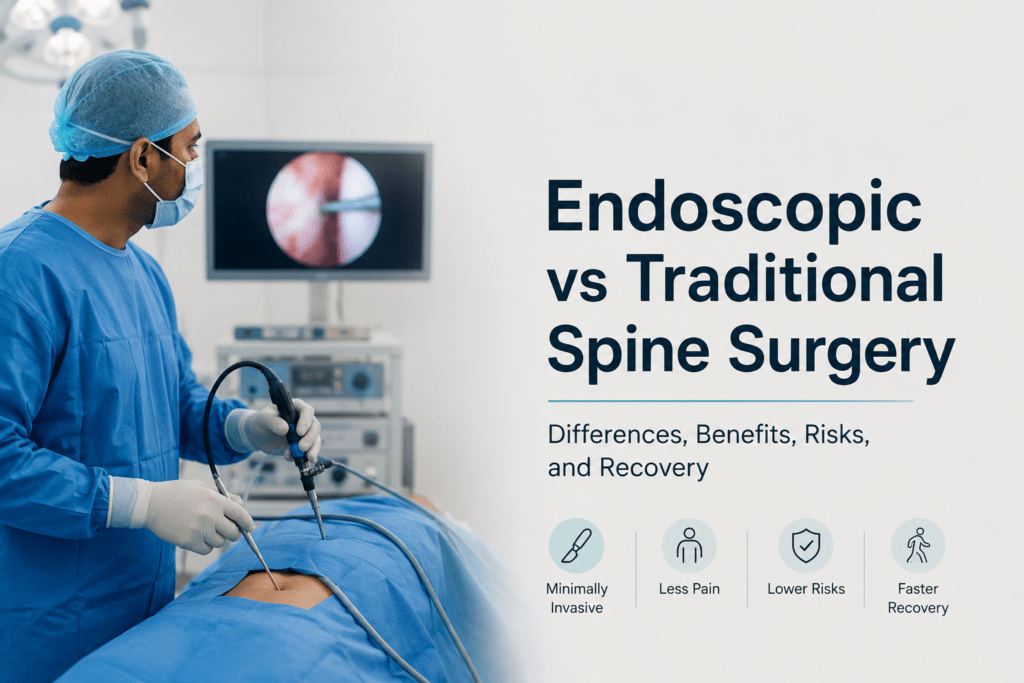
Table of Contents
What Is Endoscopic Spine Surgery?
Endoscopic spine surgery is a type of minimally invasive spine surgery (MISS) that uses a small incision and a thin tube with a camera (endoscope) to access the spine.
This surgical technique allows surgeons to delicately handle conditions like herniated discs, sciatica, and mild spinal stenosis while causing minimal damage to adjacent muscles and tissues.
The procedure is less invasive and is often associated with quicker recovery and less post-operative pain.
What Is Traditional (Open) Spine Surgery?
On the other hand, traditional spine surgery, known as open spine surgery, involves a larger incision to get direct access to the spine. This technique provides the surgeons with a wider field of view and thus is more applicable for complex or multi-level spinal conditions.
For cases requiring structural correction, spinal fusion or treatment of advanced degeneration, traditional surgery is still the gold standard, although more tissue is disrupted.
Understanding the Approach Before Comparing Them
Now that both approaches are clear individually, it becomes easier to understand the difference between endoscopic and open spine surgery. The choice is not about which is universally better, but which is more appropriate for a specific condition.
With this context, let’s look at a direct comparison.
Endoscopic vs Traditional Spine Surgery: Key Differences
The Endoscopic vs Traditional Spine Surgery difference is best understood when key factors are compared side by side.
| Factor | Endoscopic Spine Surgery | Traditional (Open) Spine Surgery |
| Incision Size | Very small | Larger incision |
| Muscle Impact | Minimal | More extensive |
| Blood Loss | Less | Higher |
| Hospital Stay | Shorter | Longer |
| Recovery Time | Faster | Slower |
| Suitability | Select conditions | Complex conditions |
The table makes the comparison easier, but what really makes them different is how much the body is impacted and how that affects healing.
Endoscopic Spine Surgery Benefits
This choice is usually explored by many patients because of the advantages associated with endoscopic spine surgery, especially in the area of quick recovery and minimal pain.
As the muscles are preserved, the cuts are small. Hence, there is little pain experienced, and in most cases, there is hardly any bleeding. This means that one can be walking even a few hours after surgery.
The other important advantage of this surgery is the reduced hospitalization period. Clinical studies have shown that endoscopic spine surgery can achieve success rates of around 85–95% for conditions like lumbar disc herniation, with significantly reduced blood loss and shorter hospital stays compared to traditional methods. These outcomes make it a reliable option for appropriately selected patients.
Benefits of Traditional Spine Surgery
Even though minimally invasive surgery is becoming very common, traditional spinal surgery provides a number of important benefits, particularly in difficult cases. One of them is that it makes it possible for surgeons to have direct and larger exposure of the spine, thus addressing a number of problems at once. For instance, in cases of spinal instability, scoliosis or multilevel degeneration, this approach becomes extremely beneficial.
Another major benefit of traditional surgery is the possibility to carry out more radical correction and stabilization of the spine when necessary. Indeed, in complicated cases, open surgery may provide more definite results in spite of a longer time of rehabilitation.
Why Recovery Time Differs Between the Two
The recovery time for endoscopic vs traditional spine surgery differs primarily because of how the body is impacted during the procedure.
Endoscopic surgery minimizes tissue damage, reduces inflammation, and limits blood loss. This allows the body to heal faster.
Since open surgery involves a larger incision and more tissue handling, recovery tends to take longer. Patients may require a few days of hospitalization, followed by weeks or months of rehabilitation, depending on the complexity of the procedure.
However, for advanced spine conditions, this approach provides the stability and correction needed for long-term results. Patients undergoing endoscopic spine surgery often return to work within 2–4 weeks, while traditional spine surgery recovery may take 6–12 weeks or longer, depending on the complexity of the procedure.
Risk Factors: Emergency vs Planned Spine Procedures
Staying focused on the comparison, the risks of endoscopic vs traditional spine surgery also differ based on the approach.
Endoscopic surgery carries fewer risks related to infection and blood loss but may not be suitable for all conditions. In some cases, limited visibility can require conversion to open surgery.
Traditional surgery, while more invasive, allows comprehensive treatment but comes with higher risks of infection, longer healing time, and post-operative discomfort.
Safety and Effectiveness: Endoscopic vs Traditional Spine Surgery
Both endoscopic and traditional spine surgeries are considered safe and effective when performed for the right indications and by experienced specialists. Endoscopic spine surgery has shown excellent outcomes for conditions like herniated discs and nerve compression, with the added advantage of reduced tissue damage and faster recovery.
At the same time, traditional spine surgery remains highly reliable, especially for complex or advanced conditions that require wider access and structural correction. Its long track record and ability to address multiple spinal issues in a single procedure make it a dependable choice in many cases.
Ultimately, safety and effectiveness are less about the technique itself and more about choosing the right approach for the patient’s condition, supported by proper evaluation and surgical expertise.
Who Should Consider Each Type of Surgery?
Choosing between the two approaches depends on the condition.
Endoscopic surgery is typically suitable for:
- Herniated discs
- Sciatica
- Mild to moderate stenosis
Traditional surgery is more appropriate for:
- Multi-level spine issues
- Severe degeneration
- Structural instability requiring fusion
This is where clinical evaluation plays a key role in determining the right path.
Cost of Endoscopic vs Open Spine Surgery
Another practical consideration is the cost of endoscopic vs open spine surgery.
Endoscopic procedures may involve higher technology costs, but shorter hospital stays and quicker recovery can reduce overall expenses.
Traditional surgery may appear less expensive initially, but can involve higher total costs due to longer hospitalization and rehabilitation.
The Role of Expert Care in Outcomes
In either case, the quality of care is a major factor that influences outcomes.
Harmony Hospital’s minimally invasive and traditional spine surgeries are patient-centric. Advanced imaging, expert hands, and specialized recovery programs ensure patients receive a treatment that is just right for them and not a one-size-fits-all.
This guarantees that the surgery is done safely, with high accuracy and in a manner that supports long-term healing, regardless of whether it is performed endoscopically or through an open incision.
Which Spine Surgery Is Better: Endoscopic or Traditional?
The answer depends entirely on the condition.
Endoscopic surgery is better when:
- The issue is localized
- Faster recovery is a priority
Traditional surgery is better when:
- The condition is complex
- Structural correction is required
Both approaches have their place in modern spine care.
Can Endoscopic Surgery Replace Traditional Spine Surgery?
Due to the rapid growth of technology, patients believe that endoscopic surgery can completely substitute open surgery.
However, both approaches complement each other. Although endoscopic surgeries are quickly developing, there is still a need for conventional surgeries to address complicated spine conditions.
Endoscopic vs Traditional Spine Surgery in India
For patients in India, the question of whether to go for endoscopic spine surgery or a conventional form depends on several factors, particularly clinical need, cost, and expertise. Though endoscopic spine surgery is more common in advanced urban centers, it does depend on availability of specialized instruments and skilled surgeons to conduct the procedure. This means that traditional forms of back surgery remain more popular owing to their wide availability across facilities.
Another consideration is cost, with patients facing higher costs in opting for an endoscopic surgery because of the cost involved in acquiring the specialized equipment needed. However, shorter recovery times and the ability to get back to work fast may make such a surgery relatively affordable compared to traditional alternatives.
Making the Right Decision
It is imperative to determine the best form of surgery through critical analysis.
At Harmony Hospital, the selection of the appropriate treatment plan is determined by an accurate diagnosis, guaranteeing that each patient receives the best medical care through either minimally invasive procedures or conventional surgery.
Also Read: Slip Disc Symptoms: Early Signs, Causes, Treatment & When to See a Doctor
Final Thoughts:
It is important for patients to understand the difference between Endoscopic Spine Surgery and Traditional Spine Surgery so they can choose the surgery that is right for them. Minimally invasive methods provide improved recovery and reduced pain, but are necessary when conditions are more severe.
The secret is selecting the most appropriate strategy, with correct diagnosis, guidance, and intervention at the right time.
FAQs:
What is the difference between Endoscopic Surgery and Open Surgery of the Spine?
The difference is that endoscopic spine surgery is done through small incisions by using a camera, whereas open spine surgery is done through a larger incision to directly access the spine.
Which spine surgery is safer, Endoscopic or traditional?
This will be influenced by the condition. Endoscopic surgery is more appropriate for less complicated problems, and traditional surgery is more appropriate for advanced or multi-level problems.
What is the recovery time for endoscopic vs traditional spine surgery?
Endoscopic surgery recovery is typically much quicker, on the order of weeks, versus traditional spine surgery recovery, which may take weeks to months.
Is endoscopic spine surgery safe and effective?
Yes, when performed by experienced surgeons for the right conditions, it is considered safe and effective with good outcomes.
What are the endoscopic spine surgery benefits?
Benefits include smaller incisions, less pain, reduced blood loss, shorter hospital stay, and faster return to normal activities.
What is the cost of endoscopic vs open spine surgery?
The endoscopic surgery might cost more, but the total cost would be less since recovery is quick whereas traditional surgery might have to be hospitalized for a longer period and might have to undergo rehabilitation for a longer period.