When choosing a hospital for cancer surgery in Ahmedabad, patients should assess the surgical oncologist’s experience with their cancer type, multidisciplinary cancer care, diagnostic and pathology support, operation theatre and ICU facilities, post-surgery care, treatment coordination, accreditation, cost transparency and insurance support. The right hospital depends on the patient’s cancer type, stage, treatment plan and overall health rather than on hospital rankings or technology alone.
The best hospital for cancer surgery in Ahmedabad is not necessarily the hospital with the highest ranking, most advanced equipment or lowest quoted price. A suitable hospital should have the right surgical oncology expertise, cancer-specific experience, multidisciplinary support, diagnostic and pathology services, critical care, follow-up arrangements and transparent costs for the patient’s individual condition.
When you have been diagnosed with cancer, all the decisions may seem urgent. However, if surgery is suggested, careful consideration must be given to selecting a hospital. As well as the surgeon’s experience, the diagnostic team, anaesthesia support, operation theatre, intensive care facilities, pathology, follow-up and the hospital’s capacity to coordinate the treatment if chemotherapy or radiation is required are all equally important.
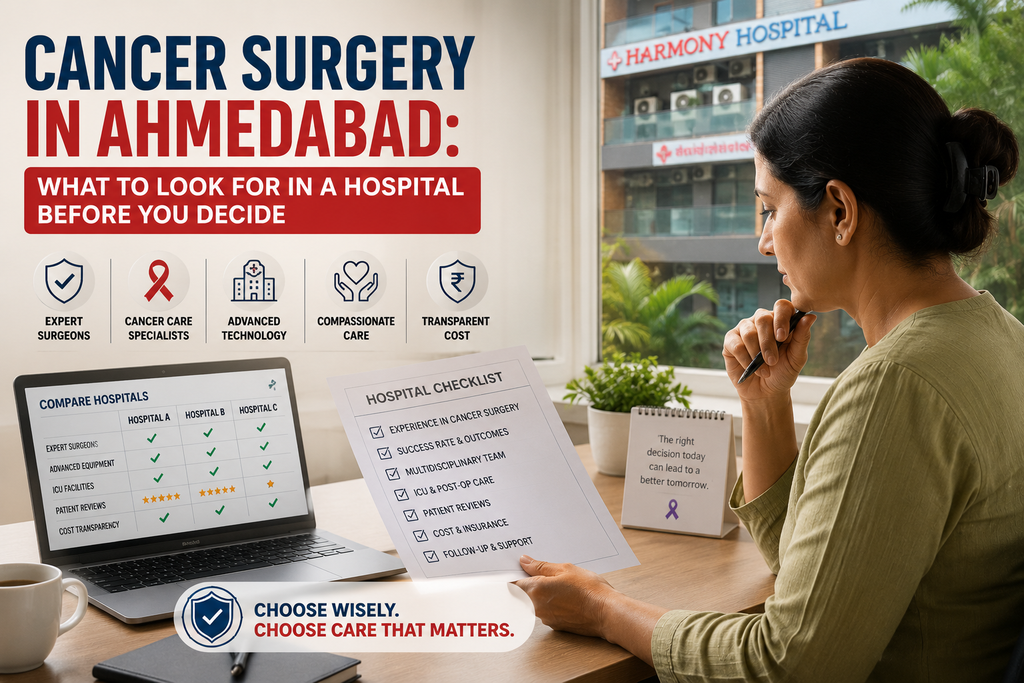
When searching for cancer surgery in Ahmedabad, do not choose a hospital only because it appears high in search results or has impressive technology. Look at the complete system of care behind the surgery.
This guide will help you to understand the essential aspects to consider before making your hospital selection for cancer surgery along with how to evaluate the best hospital for cancer surgery in Ahmedabad, the cancer surgery cost and cancer surgery success rate in Ahmedabad, Gujarat, India, and finally, how to find a good cancer surgeon in Ahmedabad for cancer surgery.
Table of Contents
What Things You should Look for in a Cancer Surgery Hospital in Ahmedabad?
A good cancer surgery hospital should not only provide an operating room and a surgeon, but also a range of other services. It should be able to coordinate care efforts, both pre- and post-surgery, ideally.
Look at the entire care journey. Not any one hospital, doctor or advertised technology. Here are a few things to consider to determine if a hospital has what it takes to take care of you safely and get you better.
| What to Check | Why It Matters |
| Surgical oncology expertise | Cancer surgery requires specialised knowledge of tumour removal, margins and surrounding tissues |
| Multidisciplinary care | Some cancers need input from surgeons, medical oncologists, radiation oncologists, radiologists and pathologists |
| Diagnostic support | Accurate imaging and pathology help determine the cancer type, stage and treatment approach |
| Operation theatre facilities | Complex cancer procedures require appropriate surgical and anaesthesia support |
| ICU and emergency care | Immediate access to critical care is important if complications or urgent medical needs arise |
| Cancer-specific experience | Experience with your particular type of cancer can be more relevant than general surgical experience |
| Minimally invasive options | Laparoscopic or robotic techniques may be appropriate for selected cancers and patients |
| Pathology and follow-up | Examination of removed tissue helps guide further treatment |
| Communication | You should understand why surgery is recommended, what it involves and what to expect afterwards |
| Financial transparency | Clear information about treatment costs, insurance and likely additional expenses can reduce stress |
The factors you need to focus on the most:
| Factor | What to Check Before Choosing |
| Surgical oncology expertise | Look for a qualified surgical oncologist with relevant experience in your type of cancer and planned procedure. |
| Multidisciplinary cancer care | Check whether surgical, medical and radiation oncologists, radiologists and pathologists can coordinate your treatment. |
| Diagnosis and staging | Ask whether the hospital has the imaging, biopsy and pathology support needed to plan treatment accurately. |
| Surgical infrastructure | Confirm that the hospital has appropriate operation theatres, anaesthesia support and post-operative monitoring. |
| ICU and emergency support | Complex cancer procedures may require access to critical care and emergency services when needed. |
| Cancer-specific experience | Ask about the team’s experience with your particular cancer rather than relying only on overall surgery numbers. |
| Minimally invasive options | Find out whether laparoscopic or robotic surgery is available when clinically appropriate. |
| Post-surgery care | Check how pathology, recovery, rehabilitation and any further cancer treatment will be coordinated. |
| Communication and transparency | The doctor should clearly explain the treatment plan, risks, alternatives and expected recovery. |
| Cost and insurance clarity | Request an itemised estimate and understand what insurance, cashless care or other financial support may cover. |
These things provide you with a convenient foundation to compare hospitals. However, a list of hospitals can’t tell you if a specific hospital is a good fit for your cancer. The next step is to examine them in greater detail, starting with the surgical oncology team.
1. Look for a Dedicated Surgical Oncology Team
Cancer surgery is not like normal surgery. The goal is not just to take out something that is visible and/or has an organ that is affected. The surgery can include the removal of the tumour and some surrounding normal tissue as part of the procedure, examination or removal of lymph nodes, reconstruction of affected tissues, or surgery for the treatment of any cancer that has spread.
This is a reason to ask if there are surgical oncologists, or doctors who specialize in the treatment of cancer, who regularly treat your kind of cancer in the hospital.
The American Cancer Society suggests asking the surgeon his or her experience in the procedure and if he or she thinks a person needs other forms of treatment before or after surgery.
Questions to ask the surgical oncologist
- How often do you perform this type of cancer surgery?
- What is the goal of the surgery in my case?
- Will the tumour and surrounding tissue be removed?
- Will lymph nodes need to be removed or examined?
- Will I need chemotherapy or radiation before or after surgery?
- What are the major risks and possible complications?
- What will recovery look like?
- What happens if surgery cannot remove all the cancer?
The goal is NOT to seek out the surgeon who guarantees the best outcome. It’s important to find a specialist who will be able to clearly explain to you what will happen to you and what the potential risks and benefits of your treatment are.
2. Check Whether the Hospital Offers Multidisciplinary Cancer Care
Treatment for cancer is nearly always a multi-doctor affair.
A patient may require a surgical oncologist, medical oncologist, radiation oncologist, radiologist, pathologist, anaesthesiologist, nutrition specialist or other specialists to address the diagnosis.
A multi-disciplinary approach enables all of the specialists to think about the same case and coordinate the treatment.
In other words, a patient with the same type of cancer might receive chemotherapy or radiation prior to surgery, but another patient with the same cancer may undergo surgery first. The choice will be based on the type of cancer, stage, location and test results and overall health.
This is one of the reasons why you should not only focus on the term “best cancer surgeon in Ahmedabad”, but also check out the entire cancer care team.
3. Make Sure the Diagnosis and Cancer Staging Are Clear
It is important to know what doctors know about cancer, and what they do not know, before undergoing cancer surgery.
Evaluation may include:
- Imaging scans
- Blood tests
- Biopsy
- Histopathology
- Endoscopy or other special tests
- Assessment of lymph nodes
- Tests to find out if the cancer has spread
Treatment should be based on clinical & diagnostic information available and not symptoms alone.
Ask your doctor: What is my report telling me about cancer and what does that mean for the treatment plan?
A hospital that is transparent about this can assist you in making an informed decision.
4. Ask About Experience With Your Type of Cancer
There are numerous surgical procedures that fall under the category of cancer surgery. Breast cancer surgery is different from colorectal cancer surgery. Head and neck cancer surgery will differ from pancreatic or liver surgery.
So, the most helpful question isn’t just,
“How many people had cancer surgeries here in the hospital?”
Ask instead:
“What is the experience of the surgeon and his or her team with my particular type and stage of cancer?”
This is especially important in the case of cancers which affect organs, the blood vessels, lymph nodes or more than one structure.
The surgical oncology department at Harmony Hospital explains the multidisciplinary care provided for primary and metastatic tumours and provides examples of experience in various cancer types involving the liver, pancreas, abdominal cavity, adrenal gland, soft tissue, breast and gastric, pancreatic, metastatic colon, appendiceal cancers, sarcomas and melanomas.
5. Evaluate the Hospital’s Surgical and Critical Care Infrastructure
Surgery can be quite simple or complicated, and may need to be monitored for some time following the surgery if a cancer is being treated.
Make sure that you research your surgery beforehand to see whether your hospital provides the necessary infrastructure for your surgery.
Important facilities may include:
- Well-equipped operation theatres
- Anaesthesia services
- The critical care unit or intensive care unit (ICU)
- Providing blood and transfusion support as needed
- Diagnostic imaging
- Pathology services
- Emergency care
- Infection-control protocols
- Post-operative monitoring
- Rehabilitation and follow-up support
The most expensive, or technically sophisticated, hospital is not always the best choice. You should find a hospital that has the necessary facilities for your type of surgery.
Another factor to consider while comparing hospitals is its NABH accreditation. The NABH standards include the following: Patient care, Medication management, Patient rights, Infection control, Patient safety, Facilities and information management. Accredited healthcare organisations can be verified by the NABH directory, which patients can access.
6. Ask Whether Minimally Invasive Surgery Is Suitable for You
For certain types of cancer surgery, laparoscopic and robotic surgery are becoming important options. But, not all patients will benefit from minimally invasive surgery.
The right way to do it is determined by:
- Cancer type
- The size and location of the tumour.
- Cancer stage
- Previous surgeries
- Overall health
- The surgeon’s expertise
- The overall purpose and difficulty of the process
Another cancer resource in Ahmedabad also states that minimally invasive surgery may be beneficial for the right patient, but the choice of the technique should depend on the type of cancer and the individual patient.
Ask:
Would minimally invasive surgery be right for me? If not, how can open surgery be safer or more effective?”
The answer should be based on the medical situation, and not based on what the hospital wants to promote a particular technology.
7. Do Not Ignore Anaesthesia and Post-Surgery Care
Patients often spend most of their time researching the surgeon and the procedure. Anaesthesia and recovery care deserve equal attention.
Ask about:
- Pre-operative health assessment
- Anaesthesia risks
- Pain management
- Monitoring after surgery
- In hospital care (ICU) on demand.
- Nutrition during recovery
- Wound care
- Mobilisation and rehabilitation
- Follow-up appointments
Surgery is one of the stress factors on the body during cancer treatment. In post-operative treatment, doctors can detect and treat complications with the help of good treatment.
The hospital has all the necessary facilities for surgical services, such as anaesthesiology, critical care and emergency services and stated that it has a well-equipped ICU, an operation theatre and 24×7 emergency care at Harmony Hospital.
8. Understand What Happens After Surgery
Cancer treatment does not necessarily end when the operation is over.
The tissue that has been removed may be sent to the pathologist following surgery. The results can indicate if further treatment should be recommended.
The treatment may also involve additional treatment, depending on the type of cancer:
- Chemotherapy
- Radiation therapy
- Targeted therapy
- Immunotherapy
- Additional surgery
- Ongoing monitoring and post-management
Before surgery, ask:
What is the expected next step after the operation?
This helps you to see the entire treatment process as one instead of surgery as a single procedure.
9. Look for Clear Communication About Risks, Benefits and Alternatives
Never feel pressured to make a decision about cancer treatment without understanding.
Your surgeon should explain to you:
Surgery is recommended for the following reasons:
- The goal of the surgery
- The expected benefits
- Possible complications
- Recovery time
- Alternatives, if appropriate
- The consequences of waiting for treatment
- It should be considered whether further treatment is necessary
The American Cancer Society also suggests asking if the objective of treatment is to cure the cancer, how much time you’re given to decide and if you have time to get a second opinion.
If the explanation is hard to understand, have the doctor explain them in simpler terms. There is also the option to bring a family member to the appointment and make notes of questions that you want to ask before coming.
10. Consider Getting a Second Opinion
A second opinion isn’t a slap in the face of your doctor. It may be able to help you determine if the diagnosis and suggested treatment is right for you.
This may be particularly useful when:
- The surgical procedure is complicated
- The cancer is in the advanced stages.
- A number of treatments exist
- There can be removal of major organs.Removal of major organs is possible.
- You’re not sure what the recommended procedure is
- You need to be sure before going any further
Bring along all previous reports of pathology, scan, prescriptions etc to the second consultation.
11. Ask for a Clear Estimate of Treatment Costs
Other costs may be associated with cancer treatment other than the surgery.
Ask the hospital for clarity on:
- Surgeon fees
- Hospitalisation
- Operation theatre charges
- Anaesthesia
- ICU charges, if required
- Medicines
- Diagnostic tests
- Pathology
- Follow-up consultations
- Additional treatment such as chemotherapy or radiation
- Insurance coverage and exclusions
Do not hesitate to ask what is included in the estimate and what may be charged separately.
Financial clarity is part of informed decision-making.
Affordable cancer surgery treatment at private hospital in Ahmedabad
When searching for affordable cancer surgery treatment in Ahmedabad private hospital, don’t opt for the hospital with a lower initial estimate, but opt for estimating the entire treatment. The initial investment is not necessarily equivalent to the cost of ICU, pathology, medicines, longer hospital stays or post hospitalisation treatment. Request an itemized quote and find out if your insurance or government health plan will pay for any of the costs.
The range of published cost available online depends on the type, stage, and surgical approach of cancer and can be widely different for each patient. As for the Ahmedabad surgery cost, current cost guides quote that surgery cost varies from a few lakh of rupees to significantly higher in case of complex surgeries, making it important to get an estimated cost for your surgery instead of a general figure.
Cancer surgery cost and success rate in Ahmedabad Gujarat India
Before choosing the cancer surgery center, the patients often check the surgery cost and success rate in Ahmedabad Gujarat India. Both require context. This is because the cost of surgery varies depending on the type of cancer, the stage, the procedure, the surgical approach, and the length of hospital and/or intensive care unit stay and other treatment requirements.
Similarly, the success rate for all cancer operations will vary. Results are linked to cancer type and stage, tumour properties, individual health, therapeutic strategy and cancer metastasis.
Beware hospitals or websites that give one statistic for cancer surgery “success rates.” Rather, ask your surgeon what the purpose of surgery is for your individual case, what you can realistically expect from the surgery and what factors may impact your prognosis.
12. Check Insurance and Cashless Support
If you are covered by health insurance, inquire with the hospital if the policy is accepted and if any forms are needed.
Also confirm:
- Whether cashless admission is available
- Whether pre-authorisation is required
- What expenses are covered
- Whether your specific procedure is covered
- What expenses may need to be paid out of pocket
Harmony Hospital provides cashless admission and accepts the mediclaim from some of the listed insurance companies. It is important for patients to verify their coverage and policy-specific terms with the hospital and insurance provider prior to treatment.
Cancer Surgery Hospital Checklist for Patients in Ahmedabad
Use this checklist when comparing hospitals:
| Question | What a Patient Should Look For |
| Does the hospital have surgical oncology services? | A dedicated surgical oncology team |
| Does the surgeon treat my type of cancer? | Relevant cancer-specific experience |
| Is there multidisciplinary care? | Coordination between relevant specialists |
| Is the diagnosis fully evaluated? | Appropriate imaging, biopsy and pathology |
| Is the planned surgery clearly explained? | Procedure, goal, risks and alternatives |
| Are minimally invasive options available? | Laparoscopic or robotic surgery where clinically appropriate |
| Is critical care available? | ICU and emergency support |
| What happens after surgery? | Pathology, follow-up and additional treatment planning |
| Can I get a second opinion? | Access to complete medical records and reports |
| Are costs explained clearly? | Written estimate and insurance information |
| Is the hospital accredited? | Verify accreditation independently, where applicable |
| Can I reach the hospital easily? | Practical access for surgery and follow-up |
Final Thoughts
At Harmony Hospital, we know that deciding on a hospital for cancer surgery is a big decision. We hope you’ll think about the entire care you could be in need of before, during and after your surgery and not just the information you find online.
We feel it is important to consider the surgeon, cancer-care team, diagnostic support, surgical infrastructure, critical care, follow-up treatment, communication and costs all together. First and foremost, you should be assured that you have a grasp of why surgery is being recommended and what you can look forward to on your treatment path.
If you are considering cancer surgery in Ahmedabad, our Oncology & Onco Surgery team will be able to talk to you about your diagnosis, surgical options and what to expect next. The environment of our multispeciality hospital, critical care and 24 hours emergency enables us to provide coordinated support when our patients require support throughout their treatment.
It is our goal to ensure that each patient and family asks questions, reads through their reports and asks for clarification when needed. If you think you may need a second opinion to make the best decision for you, we recommend that you consult another.
Contact our Oncology & Onco Surgery team at Harmony Hospital to consult about your cancer diagnosis and treatment.
FAQs:
1. What is cancer surgery?
Cancer surgery is a surgical procedure that involves removing a cancerous tumour or tissue. Some normal tissue or lymph nodes near the cancer may also have to be taken out.
2. How do I find the right cancer surgeon in Ahmedabad?
Find a certified surgical oncologist who has experience in treating your particular cancer. Remember also the multidisciplinary team, diagnostic facilities, critical care and follow-up services the hospital provides.
3. Is cancer surgery suitable for every cancer patient?
No. Surgery is determined by the type of cancer, the stage, location, health of the patient, as well as whether the tumour can be safely removed. In some cases, other treatments may be necessary prior to, or as an alternative to, surgery.
4. Can cancer surgery be done laparoscopically?
Laparoscopic and other minimally invasive surgeries may be used to treat some cancers. Appropriateness is dependent on cancer and patient characteristics.
5. Should I get a second opinion before cancer surgery?
You may ask for a second opinion, particularly if the surgery is more complicated or you are not sure about the surgery recommended. It can give you other perspective before you make your decision.
6. What happens after cancer surgery?
This will depend on the type of cancer and the procedure, hospital care, investigations, the surgeon, medicines and if further treatment is necessary. Don’t hesitate to request a hospital quote for the treatment.
7. What should I ask a cancer surgeon before surgery?
Inquire about why surgery is being performed, what it will accomplish, risks, alternatives, surgery technique, recovery, possible complications and if chemotherapy or radiation is recommended after surgery.