
A fall can result in nothing more than a bruise. However, it is the same fall that can also lead to a fracture, a tear of a ligament or a dislocation or other injury that requires proper medical care.
The tricky part is knowing the difference.
Don’t assume the severity of someone’s injury from the amount of pain or swelling that they experience. Some fractures can still be walked on, and a simple sprain might have substantial damage to the ligaments. This is why it is important to review the circumstances of the injury, how effectively you are using the affected body part, if it is improving or deteriorating and if there are warning signs of a more severe injury.
So, when is it time to seek the help of an orthopaedic specialist for a fall or injury?
When a joint, bone, muscle or tendon is painful, swollen, stiff, weak or the movement is restricted in a way that is making it harder to use the area normally, an orthopaedist evaluation may be warranted, especially if the pain is severe, getting worse or not going away with basic care. But not all injuries will require urgent medical care, and some will require an orthopaedic appointment.
When should you see an orthopaedic specialist after a fall?
Consider an orthopaedic assessment if pain, swelling, stiffness, weakness, instability or restricted movement makes it difficult to use the injured area normally, especially if symptoms are severe, getting worse or not improving. Suspected fractures, dislocations and significant injuries should be assessed promptly. Emergency warning signs such as deformity, exposed bone, severe bleeding, loss of sensation or a cold or blue limb require emergency medical care.
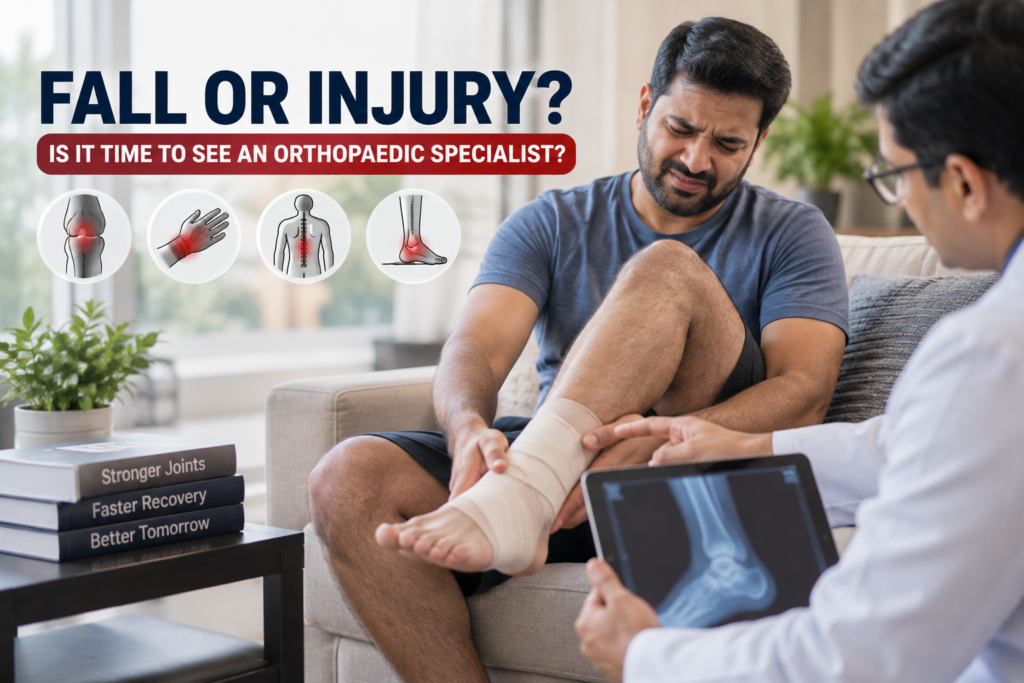
Table of Contents
Here is how to tell the difference.
Quick Guide: Do You Need an Orthopaedic Specialist?
| What you are experiencing | What you should do |
| Mild bruise or mild pain, with normal movement and gradual improvement | Rest the area, use appropriate first aid and monitor your symptoms |
| Pain or swelling that persists or gets worse | Arrange a medical assessment |
| Difficulty walking, bearing weight or using the injured arm or leg normally | Seek prompt medical assessment |
| Significant swelling, instability, severe tenderness or restricted movement | An orthopaedic assessment may be needed |
| Suspected fracture or dislocation | Seek urgent medical care |
| Obvious deformity, exposed bone, numbness, a cold or blue limb, severe bleeding or serious head, neck or back injury | Seek emergency medical care immediately |
However, what is key is that it does not mean that all falls need an orthopaedist’s consultation; however, if there are persistent or significant symptoms, they should not be ignored. A thorough exam may be useful to determine whether it is a minor injury versus a fracture or soft tissue injury that requires more targeted treatment.
When Should You See an Orthopaedic Specialist After a Fall or Injury?
The body will provide you with helpful indications to decide whether an injury requires more investigation. Look beyond the fact that you have some pain. Pay attention to what you can and cannot do after the injury.
1. You cannot put weight on the injured leg
After a fall, the most obvious indications are if someone cannot easily stand and walk normally due to pain.
This can happen with a severe sprain, ligament injury, or fracture. Being unable to bear weight does not prove that a bone is broken, but it is a good reason to have the injury assessed rather than trying to walk through it.
This is particularly important after an ankle, knee, hip or foot injury.
2. You cannot use the injured arm normally
A fall on an extended arm may cause damage to the wrist. The shoulder, elbow or upper arm may be directly impacted.
If pain, weakness or swelling prevents you from holding onto objects, or raising your arm, bending your elbow or moving your wrist normally, the injury needs medical treatment.
Sprains and soft tissue injuries can have a limited range of motion; however, fractures and dislocations can, too.
3. Swelling appears quickly or keeps increasing
It’s normal to experience some swelling after injury. The severity and progression of it is what matters.
If swelling is quick or severe, especially if it is associated with a lot of pain, bruising, limited mobility or instability, this may be a more serious injury.
For instance, swelling can occur within hours of some knee ligament injuries and a sense of instability or the knee being hard to walk on.
It is better to get the injury evaluated if the swelling keeps on rising than if it is even.
4. You have severe pain or the pain is getting worse
Pain should generally begin to settle as a minor injury heals.
It is not acceptable to say “just a sprain” when the pain is severe, is worsening or is not allowing the individual to take rest.
A fracture, big ligament injury, tendon injury and other musculoskeletal issues can cause pain.
The type of injury is also a factor. A serious fall, accident on the road or direct blow can cause a greater damage than a minor stumble.
5. The injured joint looks different from usual
If an arm, leg, finger, shoulder, ankle or other joint appears to be bent, out of place or misshapen, the chances are that it is fractured or dislocated.
This is not something to correct yourself.
A suspected dislocation or significantly displaced fracture needs urgent medical assessment. Do not try to force the joint or bone back into position.
6. You heard or felt a pop, snap or crack
A popping or snapping sensation at the moment of injury can sometimes occur with ligament or tendon injuries.
Some injuries of the knee ligaments, for instance, are accompanied by a feeling of a pop, swelling, instability or trouble bearing weight.
Just because you have a pop doesn’t mean you have torn a ligament. However, if it is accompanied by swelling, weakness, instability or loss of function, it’s a good idea to evaluate it.
7. The joint feels unstable or keeps giving way
Suppose your knee suddenly gives way when you walk. Or your ankle feels as though it might roll again. Perhaps your shoulder feels unstable after a fall.
These symptoms may indicate an injury to the structures which provide stability of the joint.
A mild injury may improve with appropriate rest and rehabilitation. But persistent instability can require a more detailed assessment and treatment plan.
8. You have numbness, tingling or weakness
Falls can usually cause pain and swelling. Loss of feeling or numbness is worthy of more focus.
If a part of the body is affected below a wound, the numbness or tingling, as well as unusual weakness or changes in the colour or temperature of the area, may be a sign that nerves or blood flow may also be affected.
They are considered serious symptoms and should be treated immediately, especially if associated with a suspected fracture or large swelling.
9. Your injury is not improving
A common mistake is waiting indefinitely because an injury was initially thought to be “only a sprain”.
Minor injuries can heal with proper home treatment. However, if the pain, swelling, stiffness, or problem with the hurt area persist without improvement, then it’s time to get the injury checked.
If the symptoms do not get better, it could indicate that the injury was not as minor as it initially looked, or that the joint was injured and needs rehabilitation to return to normal strength and motion.
Can You Have a Fracture Even If You Can Still Walk?
Yes.
Being able to walk does not completely rule out a fracture. In some cases, a person can still move a bit on the fractured limb.
Check for other signs:
- Pain directly over a bone
- Significant tenderness
- Swelling or bruising
- Increasing pain
- Difficulty moving the area
- An abnormal shape or deformity
- Pain when putting weight on the limb
A fracture should be assessed, not relied upon based on how you walk
A physical examination and imaging (such as an X-ray) may be used, if applicable, to determine the exact cause of the problem. Additional imaging (CT or MRI) may be recommended based on the injury.
When Is a Fall Injury an Emergency?
Not all injuries require a consultation with the orthopaedic specialist.
There are other signs that indicate you need urgent medical attention.
These include:
- An obvious deformity or limb that looks out of position
- A bone protruding through the skin
- Severe bleeding
- A limb or body part becoming pale, blue or unusually cold
- Loss of sensation
- Inability to move the affected body part
- Suspected serious injury to the head, neck, spine, hip or pelvis
- Loss of consciousness after a head injury
- Confusion, unusual drowsiness or other concerning changes after hitting your head
- Severe injury following a high-impact accident
Suspected fractures involving major areas such as the hip, pelvis or upper leg can require emergency attention. Serious head injuries and significant trauma also need urgent evaluation.
What if you hit your head when you fell?
Do not focus only on the visible injury.
A person may have an important head injury even when there is no obvious external wound. Loss of consciousness, confusion, unusual drowsiness or other neurological changes after a significant head impact should be treated seriously.
If there is a possibility of a neck or spinal injury, avoid unnecessary movement and seek emergency help.
Common Injuries After a Fall That May Need Orthopaedic Care
A fall can affect much more than a bone. Different tissues can be injured depending on how you landed, which part of the body took the impact and how much force was involved.
| Injury | What you may notice | Why assessment may be needed |
| Fracture | Severe pain, swelling, tenderness, bruising, deformity or difficulty using the limb | The bone may need to be immobilised or repositioned, and some fractures require surgery |
| Sprain | Pain, swelling, bruising, reduced movement or joint instability | A more severe sprain may involve significant ligament damage |
| Ligament injury | A pop, swelling, weakness or a joint that feels unstable | Significant tears may need structured rehabilitation or other treatment |
| Tendon injury | Pain, weakness or difficulty performing a particular movement | A significant tendon injury may need specialist assessment |
| Dislocation | Severe pain, deformity and inability to move the joint normally | It requires prompt medical treatment and should not be corrected at home |
| Muscle strain | Pain, tenderness, swelling, weakness or limited movement | More serious tears may require medical treatment and rehabilitation |
A sprain is a problem with ligaments, a strain is a problem with muscles or tendons. Some symptoms may overlap, and this is one reason it may be hard to assess an injury at home.
Fall Injury or Simple Bruise? How Can You Tell?
Mild pain and a small bruise that allows normal movement and is improving is not that worrisome.
It’s a different matter when the injury affects normal functioning.
Consider the following 3 levels:
Probably a minor injury
You have:
- Mild pain
- A small bruise
- Little swelling
- Normal or almost normal movement
- No numbness or weakness in the arm or hand
- Symptoms that are slowly but surely getting better
It’s possible to start self-care and closely watch the injury’s course and see how well it heals.
Needs medical assessment
You have:
- Ongoing and/or increasing pain
- If there is any significant swelling or bruising.
- Restricted movement
- Challenge to walk or use the limb
- Joint instability
- Significant tenderness over a bone
- Numbness or tingling
These symptoms should be evaluated by a health care provider as it is possible that there may be a fracture or a problem with the ligaments or other structures present and not visible.
May be an emergency
You have:
- A visible deformity
- Open wound, showing bone
- Severe bleeding
- A cold, pale or blue arm
- Major loss of feeling
- Suspicion of head, neck, spine, hip, or pelvis injury
- Loss of consciousness or if there is a concern for neurological symptoms
In such cases, don’t wait for a regular checkup.
What Should You Do Immediately After a Fall or Injury?
If the injury appears minor and there are no emergency warning signs, protect the affected area and avoid activities that make the pain or swelling worse.
If the sprain is mild, the following general treatment is recommended:
Rest: Do not do activities that make the injury worse.
Ice: A cold pack in a thin towel can be used for short periods of time. Never apply ice straight on the skin.
Compression: An elastic bandage may help control swelling when appropriate, but it should not be so tight that it causes numbness, colour changes or increased pain.
Elevation: This can help minimise swelling by elevating an injured limb.
These measures may be helpful when symptoms are minor and should not be the first step in medical assessment where symptoms are severe, worsening or not improving.
And most importantly, don’t attempt to straighten any visibly misshapen bones or joints.
Why Some Injuries Need More Than an X-ray
An X-ray is helpful in finding many fractures, but bones can be damaged, too.
A fall can also cause damage to:
- Ligaments
- Tendons
- Muscles
- Cartilage
- Nerves
- Other soft tissues
A doctor might want to use more imaging, like an MRI, CT or ultrasound, depending on the injury and what they see during the exam. For instance, MRI can give detailed images of soft tissues like ligaments and CT can give more detailed images of complex bone injuries.
Therefore, the level of investigation should be determined by the injury and clinical examination, and not by the premise that all falls require the same level of investigation.
What to Expect at the Orthopaedic Specialist’s Office?
A consultation with an orthopaedic surgeon is not just to see if a fracture is present.
The expert will want to know what happened during the injury. Was it a simple trip? Did you twist your ankle? Did you land on your hand? Was there a direct blow to the knee or shoulder?
The examination can then go on to include a check of:
- Swelling and tenderness
- Range of movement
- Joint stability
- Muscle strength
- Sensation
- The ability to put weight on or use the affected limb
If the examination indicates that the bone is broken or there may have been another injury to the structure, imaging may be recommended.
Treatment thereafter is dependent on the actual injury that has occurred.
This can involve rest and activity guidelines, medication, a brace or splint, physiotherapy and rehabilitation. Some serious injuries may require surgery, but seeing an orthopaedic specialist does not automatically mean that you will need an operation. Even significant sprains are often managed through rehabilitation and support, while surgery is reserved for selected injuries that require it.
Do Older Adults Need to Be More Careful After a Fall?
Yes.
The effects of the fall can vary by person depending on their age, bone health, mobility and medical history.
Falls can cause serious injuries in older people and when the bones are weakened, it can be more likely to break. If, however, the fall seems minor, but an older person experiences persistent pain, walking problems or new weakness or decrease in mobility after the fall, the fall should not be dismissed.
Other precautions should also be taken when using it with people who are using blood-thinning medications. These medicines may make him or her more worried about bleeding after a big fall, especially if the fall involved a head injury.
The key question is not only: “How many days has it been?”
It is also: “Is my injury actually getting better, and can I use that part of my body normally again?”
At Harmony Hospital, We Look Beyond the Pain
At Harmony Hospital, our approach to orthopaedic care is centred on understanding what has actually happened to the bone, joint, ligament or soft tissue, rather than treating pain in isolation. When an injury needs further evaluation, appropriate clinical examination and diagnostic support can help guide the next step, whether that involves conservative treatment, rehabilitation or specialist intervention.
Our team works closely with patients to develop personalized recovery plans, emphasizing gradual return to function and active participation in rehabilitation. Through education, support, and evidence-based therapies, we aim to restore mobility, reduce pain, and prevent re-injury for lasting outcomes.
The Bottom Line
A fall is not always a cause for an orthopaedic specialist. A small bruise or slight sprain that seems to be getting better can be resolved by good home treatment.
Don’t dismiss an injury just because there was no broken bone seen.
If you can’t walk on the injured foot, can’t use the injured foot normally, have a lot of swelling or instability, have numbness, don’t have pain that gets better or don’t have pain at all, or it doesn’t get better, seek medical assessment.
If there is a noticeable deformity, bare bone, major bleeding, loss of sensation, cold or blue limb or a serious injury to head, neck, back, hip or pelvic area, get emergency medical treatment rather than waiting to see your GP or orthopaedist.
In the event of doubt, it’s better to have an injury assessed than to think it’s just a sprain or bruise.
Medical note: This article is for health information purposes only and is not a substitute for a consultation with a health care professional. For serious symptoms, or if you think you may be suffering from a serious injury, get emergency medical help.
FAQs:
-
Do I need to see an orthopaedic doctor after every fall?
No. A mild bruise or sprain that is improving may not need specialist care. See a doctor if pain, swelling, instability or limited movement persists.
-
How do I know if I have fractured a bone after a fall?
Signs of a fracture include pain, swelling, bruising, tenderness, difficulty moving or bearing weight. You need an examination and, if necessary, an X-ray to confirm it.
-
Can I have a fracture if I can still walk?
Yes. Some fractures still allow you to walk. Do not ignore persistent pain, swelling or tenderness simply because you can put weight on the limb.
-
Should I see an orthopedic doctor for a sprain?
You may not need one for a mild sprain that is improving. Seek medical care if you have severe pain, significant swelling, instability, numbness or difficulty bearing weight.
-
When should I go to the emergency room after a fall?
Go immediately if you have a visible deformity, exposed bone, severe bleeding, numbness, a cold or blue limb, loss of consciousness, or a serious head, neck or back injury.