

Dengue Season in Ahmedabad: What Families Should Know Before Symptoms Get Worse
Families frequently experience fever in Ahmedabad when the monsoon comes. But not all fevers are dengue and not all dengue follows the expected course.
We believe that the first thing to remember during the dengue season is not to panic. It’s knowing what to look for, when it might be helpful to test, which medications are contraindicated and, most of all, when a patient that appears to be doing well needs immediate medical care.
Dengue activity is still observed in Ahmedabad in monsoon and post monsoon season. The Ahmedabad Municipal Corporation has reported 38 dengue cases for the period July 1-26 in July 2026.
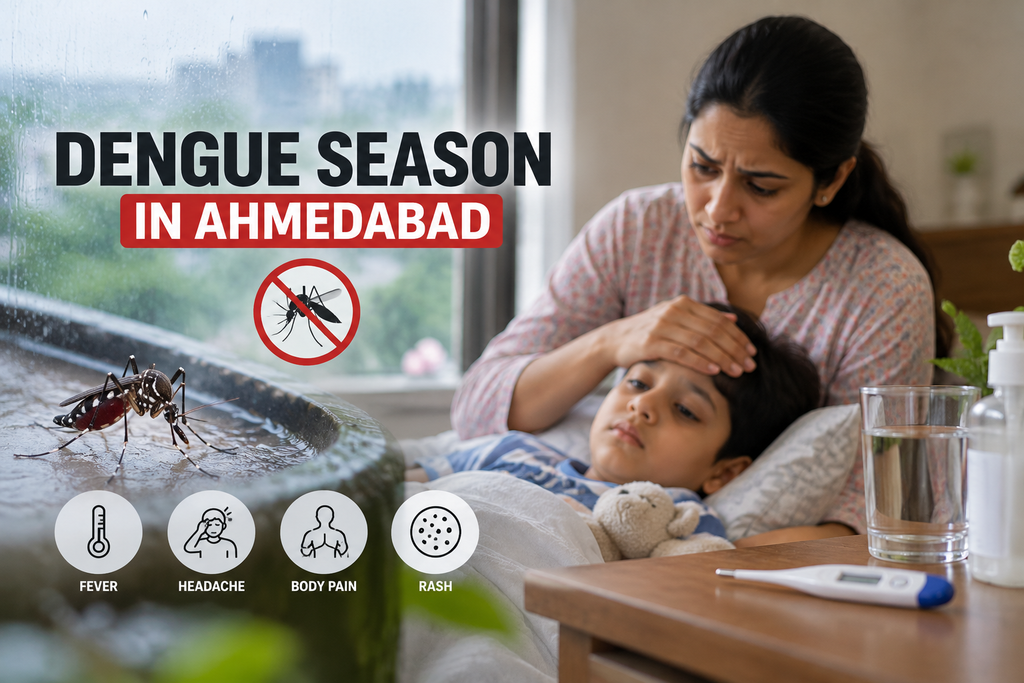
Another important note for families: Dengue is not restricted to a “dengue season”. In recent reporting from Ahmedabad, there is a possibility of the transmission window being longer due to favorable conditions of temperature and humidity for the Aedes mosquito.
In this guide, we will explain how the dengue disease typically progresses, what symptoms should be a cause of concern and how dengue is tested, why platelet counts should not be the only thing looked at and what families can do in Ahmedabad to mitigate their risk.
Table of Contents
Why Dengue Cases Increase During Ahmedabad’s Monsoon
Dengue is caused by the dengue virus and is mainly transmitted by infected Aedes mosquitoes, particularly Aedes aegypti. These mosquitoes are mainly found near human habitation and may be able to breed even in relatively small quantities of stagnant water.
Within societies, construction sites, and around homes and terraces, there may be numerous such breeding sites developed during monsoon conditions. Recycled containers, tyres, plant trays, buckets, and other containers can be suitable containers for mosquitoes to lay eggs.
Gujarat’s Institute of Disaster Management says the rain, water, temperature, and humidity affect the development and survival of mosquitoes. It also points out that the monsoon (in Gujarat, from mid-June to September) is an important period for the prevention of vector-borne diseases.
Another important point is that the mosquito responsible for the spread of dengue is not the same as the mosquito that many people are familiar with because of their night-time mosquito bites. The mosquitoes of the genus Aedes are active mainly during the day, especially the early morning and late afternoon.
Mosquito protection should not be turned off after breakfast or before bedtime. Protection is needed 24 hours a day.
What are the symptoms of Dengue Fever?
Dengue may come on quickly. An individual can experience a fever of 39C or higher and a number of other symptoms.
Common symptoms include:
- High fever
- Severe headache
- Eyelid and eye pain that is behind the eyes.
- Ostealgia – pain in the muscles and joints.
- Nausea or vomiting
- Shows signs of weakness or tiredness
- Rash
- Swollen glands (in a few cases)
Symptoms usually start 4 to 10 days after infection and typically clear up in 2 to 7 days. Most people will get better without severe illness, while a few will go on to develop severe dengue.
The challenge is that these early symptoms do not only occur in dengue. Fever, body ache and weakness can also be symptoms of malaria, chikungunya and a few other infections. WHO thus stresses that clinical features do not necessarily differentiate dengue from other infections.
That is why it is not advisable to make the assumption that all monsoon fevers are dengue and that all fevers can be treated at home without assessment.
Dengue vs Viral Fever, Dengue vs Malaria, Dengue vs Chikungunya: Why symptoms may overlap
If a person has fever in monsoon in Ahmedabad, it doesn’t necessarily mean Dengue. Symptoms are similar to those of chikungunya, malaria, and viral infections. The following are some of the differences that may serve as a frame of reference only and should not be viewed as a substitute for a physician’s examination or the proper diagnostic tests.
| Illness | Common symptoms | Clues that may help distinguish it from dengue |
| Dengue | High fever, severe headache, pain behind the eyes, muscle and joint pain, nausea, vomiting and sometimes rash | Thrombocytopenia, bleeding, abdominal pain, vomiting and plasma leakage are more suggestive of dengue. Warning signs can appear around the time the fever settles. |
| Viral fever | Fever, body ache, fatigue, headache, and depending on the virus, cough, cold or sore throat | There is no single symptom that reliably separates viral fever from dengue. Clinical assessment and appropriate testing may be needed when dengue is suspected. |
| Malaria | Fever, chills, sweating, headache, weakness and sometimes nausea or vomiting | Chills and recurring fever patterns may occur, but symptoms can overlap considerably with dengue. Malaria requires malaria-specific testing and treatment. |
| Chikungunya | Sudden fever, severe joint pain, muscle pain, headache, fatigue, nausea and rash | Severe, often debilitating joint pain is a key clue. Joint pain can continue for weeks or months after the fever improves. |
Because these illnesses can overlap, we do not recommend self-diagnosing based on symptoms alone or taking antibiotics or antimalarial medicines without medical advice.
The Most Important Dengue Warning: Fever Going Down Does Not Always Mean Recovery
This is one of the most crucial pieces of information we want all families to keep in mind.
It usually takes 2-7 days for a patient with uncomplicated Dengue fever to recover. However, the phase of the fever subsiding may also be the most crucial time of dengue.
This phase usually starts when the fever begins to subside, and generally lasts for 24 to 48 hours. In this time, certain patients may experience plasma leakage, shock, bleeding and organ complications quite rapidly.
Don’t assume that the threat is over just because your family member says, “The fever is gone, I am feeling better now.”
Monitor closely after the fever has settled for the next 24-48 hours or so.
It is important to recognise the Three Phases of Dengue.
Understanding the Three Phases of Dengue
Generally, there are three clinical stages of dengue. Clarifying to a family why monitoring is important even after the fever has returned to normal when they know where a patient might be in this course may aid in the understanding.
| Phase | Typical timing | What families should know |
| Febrile phase | Usually 2–7 days | High fever is the main feature, often with headache, pain behind the eyes, muscle and joint pain, nausea, vomiting and sometimes rash. Dehydration can also occur. |
| Critical phase | Usually begins around the time the fever settles and lasts about 24–48 hours | Most patients improve, but some can develop plasma leakage, fluid accumulation, shock, severe bleeding or organ complications. This is the phase when close monitoring is particularly important. |
| Recovery phase | Usually follows the critical phase and lasts about 48–72 hours | Leaked fluid is gradually reabsorbed, circulation stabilises, urine output increases and overall well-being improves. Platelet counts generally begin to recover later in this phase. |
This is why we don’t recommend that families use temperature as the only criteria for deciding if their child is recovered. If a patient appears to be improving due to the resolution of the fever, but still requires some degree of monitoring over the next 24-48 hours, then this is necessary.
What warning signs should families watch for?
If someone with suspected or confirmed dengue has developed:
- If the abdominal pain is intense or lasts a long time.
- Repeated vomiting
- Nose or gum bleeding
- Blood in vomit or faeces
- Drowsiness, restlessness or irritability (unusual)
- Rapid or difficult breathing.
- Lacks’ skin was pale, cold or clammy.
- Extreme weakness
- Significant decrease in urine production.
- Symptoms of dehydration or shock
Severe abdominal pain, persistent vomiting, mucosal bleeding, altered mental status, fluid accumulation and other signs are all important signs of possible progression to severe dengue, according to WHO and CDC.
Severe dengue is an emergency disease. This can happen in hours and waiting at home to see if the symptoms pass can be dangerous.
Dengue Symptoms: What Is Usually Mild and What Needs Urgent Attention?
| Symptoms or findings | What families should do |
| Fever, headache, body ache, pain behind the eyes, nausea or mild rash | Arrange medical assessment and follow the doctor’s advice. |
| Mild weakness or reduced appetite | Encourage adequate fluids and monitor the patient’s overall condition. |
| Persistent or repeated vomiting | Seek medical advice promptly, particularly if the patient cannot keep fluids down. |
| Severe or persistent abdominal pain | Seek urgent medical care. |
| Nose or gum bleeding | Seek urgent medical assessment. |
| Blood in vomit or stool | Go to an emergency department immediately. |
| Unusual drowsiness, restlessness or irritability | Seek urgent medical care. |
| Rapid or difficult breathing | Treat as an emergency. |
| Very little urine, faintness, or cold and clammy skin | Seek emergency care immediately. |
| Fever settling but new warning signs appearing | Do not assume recovery. Continue close monitoring and seek medical care promptly. |
When Should You Get Tested for Dengue?
Testing should be directed by the patient’s symptoms, duration of illness, clinical examination and the degree of local disease activity.
Timing is important for the test.
NS1 testing should be done from day 1 to 5 and IgM testing should be done from day 5 in the National Guidelines for Clinical Management of Dengue Fever 2023 in India.
Broadly:
- NS1 antigen tests: can be used to identify dengue in the early stages of the disease.
- IgM testing: More useful as the illness progresses, after the fifth day.
- PCR and other molecular tests: may be used in suitable laboratory situations for early detection.
If you get a negative test early in the disease, it doesn’t necessarily mean you don’t have dengue. The test and timing will vary according to the clinical situation.
WHO also stresses the importance of considering the stage of the infection, prior exposure and test features when determining a testing strategy.
At Harmony Hospital, tests are not the only answer, but should be taken in conjunction with the patient’s clinical condition and symptoms.
Why a CBC and Platelet Count Matter
Partnering with the appearance of Dengue, one of the most stressful factors for the family is the platelet count.
Yes, dengue may lead to a reduction in platelet count (thrombocytopenia). But a blood platelet count is not enough to make sure that a patient is suffering from severe dengue.
Doctors also assess:
- Blood pressure and pulse.
- Hydration status
- Urine output
- Haematocrit
- Bleeding
- Abdominal symptoms
- Breathing
- Mental status
- When indicated, liver function and kidney function are performed.
- The trend of blood counts according to time
The trend may be more useful than a platelet count.
Does every low platelet count require platelet transfusion?
No.
Dengue guidelines in India have not recommended platelet transfusion as a routine measure due to a drop in platelets. Treatment depends on the clinical scenario, bleeding and other risk factors.
This is also consistent with the latest WHO clinical guideline, which does not recommend platelet transfusion in patients with thrombocytopenia and without active bleeding due to lack of evidence.
This is a key difference as unneeded transfusion can put patients at avoidable risk.
What Should You Do at Home If Dengue Is Suspected?
If a doctor feels the patient can be managed at home, supportive care and close monitoring become very important.
1. Keep the patient adequately hydrated
Drink plenty of fluids as directed by the doctor. Replacing fluids (oral rehydration solutions and other acceptable fluids) can help keep you hydrated.
If the patient is vomiting frequently or is unable to take in sufficient fluids, a medical evaluation is more critical.
2. Use paracetamol when appropriate
Paracetamol is frequently used in the treatment of fever and pain associated with dengue.
Avoid aspirin or non-steroidal anti-inflammatory drugs (NSAIDs) like ibuprofen unless prescribed by a doctor, as these medications may make bleeding more likely.
3. Do not self-medicate with antibiotics
Dengue is a viral disease. There is no treatment for dengue per se that can be treated with antibiotics.
If another infection is suspected, a doctor will be able to determine if an antibiotic is necessary.
4. Keep track of the illness day
Write down the date when fever started.
This is a relatively simple step to help the doctor determine if the patient is still in the early febrile stage or nearing the critical stage or beginning the recovery stage. It can also be helpful in deciding on the most suitable dengue test.
5. Monitor the patient, not just the thermometer
A falling temperature is not enough to declare recovery.
Pay attention to drinking, vomiting, urine output, abdominal pain, bleeding, breathing, alertness and overall behaviour.
What Should You Not Do If Dengue Is Suspected?
Common reactions to Dengue can cause unnecessary risk or delay timely treatment. We recommend that families:
- Do not take aspirin or ibuprofen unless a doctor specifically advises otherwise.
- Do not start antibiotics or antimalarial medicines without medical advice.
- Do not judge the severity of dengue from a platelet count alone.
- Do not rely on papaya leaf products or other home remedies instead of medical assessment.
- Do not assume that a falling fever means the illness is over.
- Do not wait for severe bleeding before seeking emergency care if warning signs are already present.
- Do not give intravenous fluids at home without medical supervision. Fluid requirements in dengue need to be individualised, particularly during the critical phase.
Can Dengue Spread From One Family Member to Another?
Dengue does not normally spread directly from person to person through casual contact.
The usual transmission cycle involves an infected person, an aedes mosquito and another person. When a mosquito bites an infected person during the period when the virus is present in their blood, it can subsequently transmit dengue to another person.
This means that if someone at home has dengue, protecting that person from further mosquito bites is also important.
Use mosquito nets, screens, repellents and appropriate clothing. This reduces the opportunity for mosquitoes to acquire the virus from the infected person and spread it to others.
How We Can Reduce Dengue Risk Around Our Homes in Ahmedabad
Dengue prevention is not limited to spraying mosquitoes after they appear. The most effective everyday habit is to remove breeding sites.
We recommend that families check their homes and surrounding areas at least once a week.
Check for still water in:
- Plant pots and saucers
- Buckets and tubs
- Water tanks and containers
- Glass bottles and cans that have been thrown out.
- Old tyres
- Coolers
- Construction materials
- Roofs and terraces
- Drainage areas
- Leave balconies open to let air flow in.
- Any of the objects that can collect rainwater
Empty, clean or cover water-storage containers frequently. Do not allow rainwater to accumulate on items that can collect it.
WHO recommends environmental management measures such as removing artificial water-holding containers and regularly cleaning and covering domestic water-storage containers.
Remember: “clean water” can also be a problem
A common misconception is that mosquitoes breed only in dirty drains.
Aedes mosquitoes can breed in relatively clean, stagnant water collected in household and outdoor containers. This makes checking balconies, terraces, gardens and construction areas particularly important during monsoon.
Who Should Be Monitored More Carefully?
All people with a suspected case of dengue need a proper medical evaluation, however, some individuals may need more frequent monitoring as they could be at a higher risk for complications.
These include:
- Young children
- Older adults
- Pregnant women
- Those who have underlying health conditions that are serious enough to require additional medical treatment
- Those who have already suffered from dengue
- Patients who are unable to get sufficient fluid intake
Individuals who have had a dengue infection are not immune from future infections. There are four different strains of the dengue virus, and immunity to one strain results in immunity to that specific strain, and not to the other three. An additional infection with a different type may be associated with increased risk of more serious illness.
Dengue in Children: What Parents Should Watch For
Symptoms may be similar to other common infections and younger children may not be able to accurately express their symptoms. Therefore, hydration, behaviour/urine output and temperature should be monitored closely by parents.
If a child with suspected dengue fever continues to vomit, refuses or cannot swallow fluids, urinates less than usual, is very sleepy or irritable, has severe abdominal pain, bleeding or has trouble breathing, seek immediate medical attention, or if a child suddenly appears much worse, seek immediate medical attention.
Fever, vomiting or inadequate fluid intake increases the risk of dehydration for infants and young children. Do not delay in reaching out to a doctor if a child’s platelet count is dropping because they may be over-hydrated or acting in an abnormal manner.
Dengue Myths Families Should Stop Believing
Myth 1: “If the fever has gone, dengue is over.”
Not necessarily. Critical phase may start during the resolution of the fever. The next 24-48 hours may be critical for monitoring.
Myth 2: “A low platelet count automatically means severe dengue.”
No. Platelet count is just one of the assessments. Other clinical changes that are observed are bleeding, leakage of plasma, shock, organ involvement.
Myth 3: “Everyone with dengue needs hospitalisation.”
In some instances, patients who have no warning signs who are stable, adequate oral fluid intake, and not at significant risk, may be treated as outpatients and followed with appropriate follow-up.
Myth 4: “Papaya leaf juice can replace medical treatment.”
The quality of evidence is insufficient to recommend papaya leaf products as a replacement for medical assessment and supportive treatment for dengue. Dengue patients should not delay seeking medical help by using home remedies.
Myth 5: “A dengue test is enough to decide whether someone is safe.”
No. Symptoms, illness day, examination and other investigations must be taken into account when interpreting a laboratory result.
When Should You Visit a Hospital?
Arrange medical assessment when there is a high fever, important symptoms or a patient is in a higher risk group, if there is a suspicion of dengue. Not all patients suffering from dengue require admission to hospital, but those with warning signs or severe dengue should be treated in hospital.
If there is: Immediately go to an emergency department if there is:
Abdominal pain, persistent vomiting, bleeding, difficulty breathing, weakness, drowsiness or restlessness, fainting, cold/clammy skin, very little urine or any sudden worsening.
Don’t wait until platelets get very low to get assistance.
It’s because that if a person is diagnosed with severe dengue, it can develop very quickly and supportive treatment – when recognized early – can make the difference between life and death. According to WHO, early recognition and timely access to quality health services significantly reduce the risk of death due to severe dengue.
At Harmony Hospital, we treat fever and suspected dengue fever the following way:
A high fever can be a worry especially when dengue is prevalent in Ahmedabad.
We take a more holistic approach, examining the cause of a symptom or lab result and not just the symptom or lab value itself. We evaluate the patient’s clinical presentation and determine whether a diagnosis of dengue is suspected or not, and suggest further investigations and whether the patient needs to be monitored or hospitalised.
Harmony Hospital offers 24-hour emergency and trauma medicine, critical care services, diagnostic services and general medicine services.
Most importantly, we don’t want families to wait when it is no longer appropriate.
Seek medical attention immediately if your family member’s fever persists and they seem even weaker, are unable to drink fluids, are developing bleeding or abdominal pain, are becoming sleepier or more restless, are struggling to breathe or if the fever subsides.
Our Message to Ahmedabad Families This Dengue Season
We don’t want a family to be scared all the time of the monsoon. We want them to be prepared.
While the vast majority of cases of Dengue are treatable, there is a risk of serious dengue developing rapidly. The biggest error is assuming that falling fevers imply that the danger is over.
When someone in the home experiences a fever, take the signs and symptoms seriously, seek medical advice when needed, monitor the illness day, drink plenty of fluids, refrain from medications that increase the risk of bleeding and closely monitor for signs of problems.
And when those warning signs come upon you, don’t wait until tomorrow.
We at Harmony Hospital are dedicated to providing timely medical assessment and emergency care to the families of Ahmedabad when they need it.
Medical note: This article is for health education purposes only and should not be a substitute for a thorough examination by a qualified physician. Dengue may mimic other infections and treatment should be based on the clinical condition of the patient.
-
What are the first symptoms of dengue?
Dengue commonly begins with sudden high fever, headache, pain behind the eyes, muscle and joint pain, nausea, vomiting and sometimes a rash.
-
How many days does dengue fever last?
The febrile phase is usually 2-7 days in duration. There is then a critical period in the course of the disease when about the time of the cessation of fever, some patients become worse.
-
Is dengue dangerous after the fever goes away?
It can be. The warning period starts around the time the fever clears and the critical period is typically 24 to 48 hours.
-
When should I get tested for dengue?
Testing depends on the day of illness. India’s 2023 national guidelines recommend NS1 testing during days 1 to 5 and IgM testing after day 5, although the treating doctor may recommend a different approach based on the patient’s condition.
-
What platelet count is dangerous in dengue?
There is no single platelet number that defines severe dengue. Doctors assess platelet trends together with bleeding, haematocrit, circulation, urine output and other signs of disease severity.
-
Can dengue be treated at home?
Some patients with dengue without warning signs can be managed at home with medical guidance, adequate fluids, rest and close monitoring. Patients with warning signs or severe dengue require hospital-based care.