
For most patients, laser surgery (EVLT) is now the preferred treatment for varicose veins over traditional vein stripping. It requires no general anaesthesia, has a faster recovery, and leaves minimal scarring. Traditional open surgery remains relevant for complex or recurrent cases where laser access is not sufficient.
Varicose veins are far more common than many people realise. They affect people across different age groups and professions, especially those who spend long hours on their feet. An Indian study found that 46.7% of females and 27.8% of males had varicose veins, with prolonged standing identified as one of the most significant risk factors. This highlights that varicose veins are not just a cosmetic concern but a widespread health condition that deserves timely attention.
If you’ve been told you need treatment you may be wondering about the best choice between laser surgery vs traditional surgery for varicose veins. Both treatments aim to close or remove damaged veins and improve blood flow, but they differ in how they are done, the recovery involved and when they are recommended.
The information in this guide will help you understand how both surgeries work, how the success rates, recovery times, costs, and long-term results compare, and when each would be most appropriate and what questions to ask your vascular surgeon.
This guide is written for patients in India who have been diagnosed with varicose veins and are trying to choose the right treatment path.
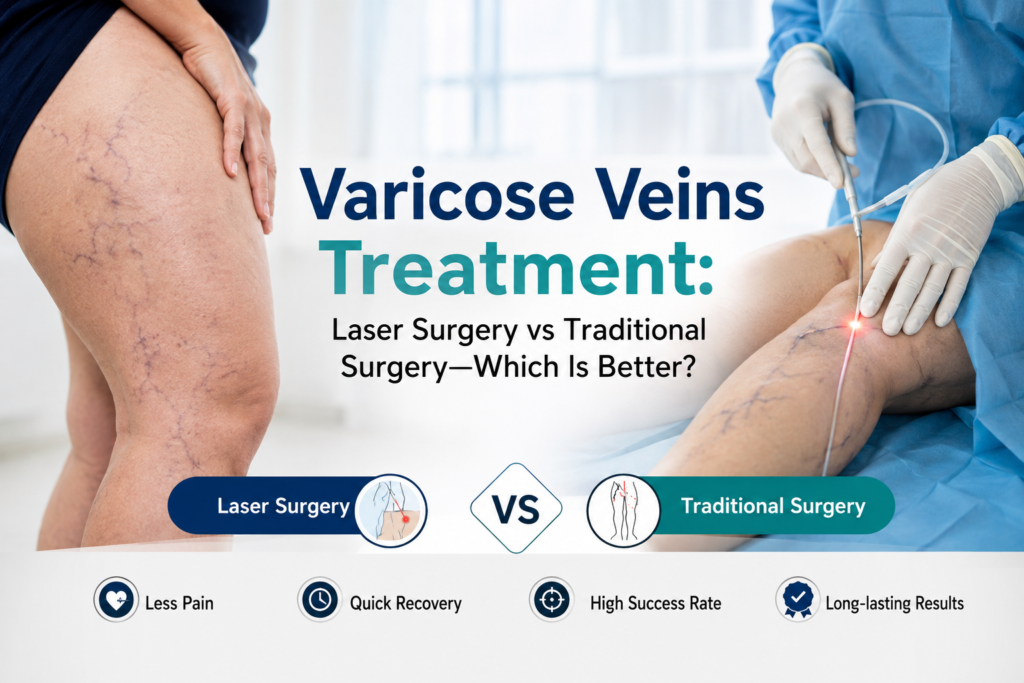
Table of Contents
What Varicose Veins Are and Why They Need Treatment
Most people think varicose veins are simply enlarged veins that change the appearance of the legs. This may be true in the early stages, but the condition can progress slowly and if left untreated can result in pain, swelling, skin damage and even hard to heal ulcers.
Knowing how varicose veins form, and when they require medical attention, can help prevent long-term problems.
How Varicose Veins Develop in the Legs
Blood is transported upward from the legs to the heart in healthy veins of the legs by tiny, one-way valves. Your calf muscles are assisting with pumping blood against gravity with each step you take.
These valves can weaken or become damaged, and no longer seal properly. Some of the blood circulates backward, pooling in the vein. This additional pressure over the years stretches, twists and enlarges the vein.
It is called “venous insufficiency” and is the cause of most varicose veins.
They are usually found on legs on the calf and thighs and can occur in any superficial veins of the legs.
Some common symptoms are:
- Blue or purple varicose veins
- Leg pain or heavy feeling
- Leg swelling near the ankles
- Tingling or burning feeling
- Cramping in the legs, particularly at night time
- Itching near the affected area
- Worsening of symptoms when standing for a long period of time
Most patients experience an improvement in symptoms when their legs are raised or after walking, because this makes the blood circulate to the heart.
When Varicose Veins Stop Being Just Cosmetic
Emergency Surgery is not required for everyone suffering from varicose veins. Once symptoms or complications affect daily life, treatment is necessary.
If you have any of the following, you should be medically evaluated:
- Ongoing pain or feeling heavy in the legs.
- Swelling that will not go away with rest
- Frequent itching/skin irritation around veins
- The leakage of blood from a varicose vein.
- Skin turning dark, thickened or hard around the ankle area
- A wound or ulcer that does not heal
- Superficial vein inflammation or blood clots that are recurrent.
Ignoring these warning signs allows the underlying venous disease to progress. As time goes by, the growing pressure in the vein may permanently destroy the skin and surrounding tissues.
Fortunately, today there are treatments available that will help enhance the appearance of the veins, as well as restore healthy blood flow, alleviate symptoms, and diminish risk of future complications.
Who Is Most at Risk in the Indian Context
Varicose veins can affect anybody, although there are some risk factors.
The major risk factors are:
- Family history of varicose veins.
- Increasing age
- Pregnancy
- Obesity
- If you don’t exercise regularly, you may develop lower back pain and stiffness.
- History of previous leg injury, deep vein thrombosis (DVT)
- Jobs involving extended periods of standing.
The veins in the legs have to work harder to get the blood back up to the heart when standing for extended periods of time each day.
This is especially true in India where a lot of jobs require a lot of standing. Teachers, surgeons, nurses, factory workers, retail workers, traffic policemen, chefs, salon professionals, security guards and hospitality workers are more likely to develop the condition.
The choice of a treatment that provides durable results with minimal downtime is of particular importance for these individuals. A systematic review published in PubMed Central found that Endovenous Laser Ablation (EVLA) achieved a vein closure (occlusion) rate of 94.9%, compared with 92.0% for traditional surgical stripping, demonstrating that minimally invasive treatment is at least as effective as conventional surgery. The review also reported a five-year recurrence rate of 38.6% for EVLA and 34.6% for surgery, while Radiofrequency Ablation (RFA) had the lowest recurrence rate at 18.7%.
If you spend most of your day on your feet then you should speak with a vascular specialist about varicose veins treatment for standing workers. Treatment early on can alleviate symptoms, enhance mobility and prevent complications developing that may affect your life.
How Traditional Vein Stripping Surgery Works
Prior to the introduction of minimally invasive techniques, the standard treatment for varicose veins was conventional vein stripping. This is still done today, especially in patients with complex venous anatomy, extensive disease or recurrent varicose veins where endovenous procedures may not be appropriate.
What differentiates it from laser treatment is that laser treatment closes the vein from the inside, but traditional surgery actually removes the affected vein with small incisions.
What the Procedure Involves Step by Step
The traditional technique for vein stripping is carried out in an operating room under general or spinal anaesthetic.
The process can be done in a variety of ways, but generally consists of the following steps:
- A tiny incision is made in the groin where the superficial vein meets the deep veins.
- A second small cut is made in the leg, usually near the knee or ankle.
- A small surgical wire (vein stripper) is inserted into the unhealthy vein.
- The vein is tied off and is gently extracted through the cut.
- Phlebectomy is the removal of smaller varicose veins, made via small incisions.
- Incisions are closed and a compression bandage or stocking applied.
The surgery typically takes 60 to 90 minutes, depending on the number of veins to be treated and the extent of the surgery (one or two legs).
Patients are encouraged to walk shortly after surgery to increase circulation and decrease the risk for blood clots.
Recovery After Traditional Vein Stripping
Vein stripping recovery is usually more prolonged than the other procedures.
Most patients will experience:
- Trauma to the affected vein for 2-4 weeks
- Low to moderate pain; typically can be managed with pain medicine.
- Compression stockings for 1 – 2 weeks
- Slight swelling and pain
- No physical activity during recovery stage 1
Most people get back to the desk job in two to four weeks, and if they have a physically demanding job, they may need more time before they’re back at work.
After surgery, patients are encouraged to walk, but strenuous exercise, heavy lifting, and prolonged standing must be avoided until the surgeon advises otherwise.
Scars are typically small and may fade with time, but are more visible than what’s experienced with endovenous laser treatment.
When Traditional Surgery Is Still the Right Choice
There are certain situations where traditional surgery is still an important option, even if most people prefer less invasive treatments.
Your vascular surgeon might consider vein stripping if you:
- The veins that are affected are extremely large or tortuous making it difficult to place the catheter.
- The varicose vein problem has returned following the treatment.
- Veins have a poor anatomical structure for endovenous methods.
- Several veins need to be surgically treated.
- You do not have access to or do not require endovenous equipment.
A detailed duplex ultrasound of the affected veins will always be necessary to make the decision and to determine the best treatment.
For other patients, however, newer, less invasive procedures have the same or better results and involve a faster recovery.
How Laser Surgery (EVLT) for Varicose Veins Works
Endovenous Laser Treatment (EVLT) has revolutionized the treatment of varicose veins in the last 20 years. This technique does not involve removing the diseased vein, but rather sealing it from the inside, with controlled laser energy.
Endovenous laser treatment for varicose veins in India is readily available these days and one of the most preferred treatment methods for patients who are fit to receive it as it is minimally invasive and effective and one can resume to normal activities within a very short duration after the treatment.
What EVLT Does Inside the Vein
EVLT is carried out through the guidance of ultrasound, so the surgeon is able to treat the vein that will be diseased with great precision.
The following process is normally followed:
- Duplex ultrasound is used to identify the affected vein.
- A small hole is cut in the skin, typically under the knee.
- The laser fibre is directed into the vein.
- Local anaesthetic is injected into the tissue that surrounds the vein.
- The fibre is then slowly pulled through the tube, with laser energy being applied.
- The laser heat collapses the walls of the vein, sealing it off.
- Blood naturally “steers clear” of the other unhealthy veins and flows around them.
The vein will then slowly disappear over the coming weeks and months.
The procedure is essentially performed through a needle size puncture, with minimal tissue disruption, minimal bleeding and much less post procedural discomfort.
The Role of Tumescent Anaesthesia
Many people are amazed at the fact that in most patients EVLT can be done using tumescent local anaesthetic only, avoiding general anaesthetic.
Tumescent anaesthesia is the technique of injecting a dilute solution of local anaesthetic around the vein in question.
This is for several very good reasons:
- It dulls down the area to be treated.
- It insulates surrounding nerves and skin from the heat.
- It constricts the vein and thus works more efficiently with the laser.
- It enhances the patient’s comfort during the treatment.
This may be a great benefit to those people who have medical conditions which may make them more vulnerable to the effects of general anaesthetic.
EMLT may be a great option for those seeking a treatment for varicose veins without general anaesthetic, when the vein anatomy is ideal.
Procedure Time and Same-Day Discharge
Many patients choose EVLT because it is an easy procedure.
Typically, the process takes 30-60 minutes, depending on the quantity and dimension of the veins being treated.
After a short period of observation, most patients are able to:
- Walk right after the procedure
- Come back home the same day
- Return to light, normal activities within 24 hours.
- Work back to the office in 1-3 days, depending on how they feel.
Compression stockings are usually recommended for a brief time to aid healing and comfort, though.
The majority of patients only feel soreness or tightness on the vein that was treated, but this subsides within a few days or so.
This is one of the primary considerations for many people weighing traditional surgery vs laser for varicose veins, as it is a shorter downtime. Normal life is a big difference for working people or those with children to raise as well as self-employed people to return to normal life as soon as possible.
The other common concern is the recovery time associated with varicose veins laser surgery. The recovery period is no different from person to person, but is much shorter than following open surgery, and many people can resume normal activities within one to two days of the surgery and return to more strenuous activities after medical clearance.
Direct Comparison — Laser vs Traditional Surgery
When considering the best varicouse veins treatment between laser and surgery, there are several things to take into account: how bad is your condition, the structure of your veins, your overall health and your surgeon’s opinion. For the majority of patients with good vein anatomy, however, Endovenous Laser Treatment (EVLT) is now the most popular treatment, as it is minimally invasive, recovery is more rapid and results are similar to traditional vein surgery.
The table below highlights the key differences between laser surgery vs traditional surgery for varicose veins.
| Feature | Laser Surgery (EVLT) | Traditional Vein Stripping |
| Procedure | Closes the vein using laser energy | Surgically removes the affected vein |
| Anaesthesia | Usually local (tumescent anaesthesia) | Usually general or spinal anaesthesia |
| Incisions | Needle-sized puncture | Small surgical incisions |
| Hospital Stay | Same-day discharge | May require an overnight stay in some cases |
| Recovery | Usually 1 to 7 days for routine activities | Usually 2 to 4 weeks |
| Pain After Procedure | Mild discomfort | More postoperative pain and bruising |
| Scarring | Minimal | Small but visible scars |
| Suitable For | Most uncomplicated varicose veins | Complex, recurrent, or anatomically unsuitable cases |
Neither treatment is more effective than the other, but one that suits your individual condition is best.
Success Rates and Recurrence Data Compared
One of the most significant queries that patients ask when it comes to comparing traditional surgery with laser for varicose veins is whether or not laser treatment is as effective in the long run.
At present, there is evidence that it is.
As discussed earlier, in a systematic review published in PubMed Central, the results of Endovenous Laser Ablation (EVLA), Radiofrequency Ablation (RFA) and conventional surgical stripping were compared. The study revealed that EVLA had a vein occlusion success rate of 94.9% compared to 92.0% for conventional surgical stripping. The occlusion rate in Radiofrequency Ablation (RFA) was also reported as 94.4%.
Long-term outcomes were also evaluated. The recurrence rates were 18.7% for RFA, 34.6% for surgical stripping, and 38.6% for EVLA at 5 years. All three treatments are extremely effective in the proper patient and the difference in the recurrence rates long term is due to the various factors involved – vein anatomy, disease severity, surgical technique, etc.
Most patients will be satisfied with this outcome and know that these procedures can be used to achieve similar results to traditional surgery, and in some cases even better, with less pain and shorter recovery times after the surgery.
Anaesthesia and What It Means for Patient Risk
The most significant distinction between laser treatment and conventional surgery is the anaesthetic needed.
Most commonly performed using general or spinal anaesthetic, these patients need to be further assessed before and after the surgery, they need to fast, and recovery takes a longer period following the procedure.
In contrast, EVLT is typically done under tumescent local anaesthetic. The patient is conscious and the treated area is totally numb and in most cases no general anaesthetic is required.
It is particularly beneficial for many patients, especially older people or those with pre-existing health issues, as it decreases the dangers involved with the anaesthetic and helps them to recover sooner.
EVLT is a good option if you want to have varicose veins treatment without general anaesthesia, as long as your vascular surgeon decides that your veins are compatible with EVLT.
Scar and Cosmetic Outcomes After Each Procedure
One of the first symptoms that people notice is the appearance of bulging veins. The main reason for the procedure is to restore healthy blood flow and alleviate symptoms, although enhancing the appearance of the legs is a nice added benefit.
However, there are differences in cosmetic results between the two procedures.
As EVLT is a procedure that is done through a very small needle puncture, it usually does not leave any scarring. The bruising is mild and will pass within the next few weeks.
Older surgery is performed with small incisions that remove the diseased vein. These cuts are made so carefully and typically heal very well, but they may leave behind tiny scarring. There is also more bruising and tenderness after the treatment than with laser treatment, and the bruising can last for longer.
Laser therapy can provide a cosmetic benefit in addition to its clinical benefits for patients who want to wear shorter clothes and minimize marks on their legs or wish to return to work without having to do things differently.
Other Treatment Options Patients Should Know About
Laser treatment and conventional surgery are not the only ways of treating varicose veins. Your vascular surgeon may recommend yet another minimally invasive procedure based on the size of the veins involved, your symptoms, and the results of your duplex ultrasound exam.
Having some idea of these options may help you to make a more informed choice regarding treatment.
Radiofrequency Ablation as an Alternative to Laser
Another minimally invasive procedure that functions in a similar manner to EVLT is Radiofrequency Ablation (RFA).
RFA treats the diseased vein from the inside with controlled radiofrequency heat (heat, but not laser) to seal it. Over time the treated vein will fade and disappear.
The procedure is similar to EVLT:
- Is carried out under local anaesthetic.
- Does not need much skin to be punctured
- Allows same-day discharge
- Provides a rapid recovery in the least stressful way
Some vascular surgeons prefer one procedure over the other because of the condition of the vein, equipment availability, or because of their experience. The two treatments are considered first line for most patients with varicose veins.
Sclerotherapy for Smaller and Spider Veins
Sclerotherapy is commonly recommended for small varicose veins and spider veins that do not require surgery.
During the procedure, a special solution or foam is injected into the affected vein. This irritates the vein lining, causing it to collapse and eventually disappear as the body absorbs it.
Sclerotherapy is:
- Performed in the outpatient clinic
- Does not require anaesthesia
- Takes only a few minutes
- Often requires multiple treatment sessions for the best results
It is important to note that sclerotherapy is generally not suitable for treating large incompetent veins, where EVLT or RFA usually provides better long-term outcomes.
Cyanoacrylate Glue as a Non-Thermal Option
A newer type of varicose vein treatment involves closing the damaged vein with a special medical adhesive (cyanoacrylate glue).
This technique doesn’t involve heat, unlike laser treatment or RFA. Rather, the glue closes the vein, and the blood circulates through healthier veins.
Potential advantages include:
- No nerve damage due to heat.
- Little or no need for tumescent anaesthesia.
- Only a little bit of discomfort during the procedure
- Same-day discharge
Nevertheless, cyanoacrylate closure is not appropriate for all patients, and may not be available in all treatment centres. Your vascular surgeon will evaluate your vein anatomy, symptoms and overall health to decide if it’s suitable for you.
Cost Comparison for Indian Patients
Cost is an important consideration when choosing between treatment options. However, the cheapest procedure is not always the most cost-effective in the long run. Recovery time, hospital stay, time away from work, and the likelihood of needing additional treatment should all be considered alongside the initial procedure cost.
Why Laser Costs More Upfront But May Save More Overall
However, the cost of varicose veins laser surgery in India is usually greater in most Indian hospitals when compared to vein stripping as it demands dedicated laser machines, disposables and sophisticated imaging technologies.
However, many patients recover much quicker after EVLT, which may help to lower indirect costs of treatment including:
- Time away from work
- No income for self-employed people for a day
- Hospital admission charges
- The expenses for extended recovery periods
- Supportive care for bigger surgical wounds
Some centres might offer a lower procedure cost for traditional surgery, but patients may need a longer recovery time before they can resume their regular activities.
The total cost of treatment depends on several factors, including:
- The severity of the varicose veins
- Whether one or both legs require treatment
- The type of procedure performed
- The hospital and city
- The surgeon’s expertise
- Additional procedures such as phlebectomy or sclerotherapy
Instead of choosing a treatment based on price alone, discuss the expected outcomes, recovery time, and long-term benefits with your vascular surgeon.
Insurance Coverage for Varicose Vein Treatment
Many patients assume that varicose vein treatment is purely cosmetic and therefore not covered by insurance. This is not always true.
If treatment is medically necessary because of symptoms such as:
- Persistent pain
- Leg swelling
- Bleeding veins
- Skin changes
- Venous ulcers
- Chronic venous insufficiency
Many health insurance providers in India may offer partial or full coverage, depending on the policy terms.
Coverage varies between insurers and plans. Before scheduling treatment, ask your hospital’s insurance desk about:
- Pre-authorisation requirements
- Documents needed for approval
- Waiting periods, if applicable
- Inclusions and exclusions under your policy
Gaining a detailed understanding of your coverage in advance can help avoid unexpected expenses.
Warning Signs That Treatment Cannot Be Delayed
Varicose veins usually progress gradually. However, certain symptoms indicate that the condition has advanced and requires prompt medical attention.
Ignoring these warning signs increases the risk of permanent skin damage, recurrent infections, and chronic wounds.
Skin Changes Around the Ankle or Lower Leg
As venous disease worsens, increased pressure inside the veins affects the surrounding skin and tissues.
You may notice:
- Brown or dark skin discolouration
- Thickened or hardened skin
- Persistent itching
- Dry, inflamed skin
- Tightness around the ankle
These changes suggest chronic venous insufficiency and should not be ignored. Early treatment can improve circulation and reduce the risk of further complications.
Non-Healing Wounds or Ulcers Near the Ankle
One of the most serious complications of untreated varicose veins is a venous leg ulcer.
These ulcers usually develop near the inner ankle and may:
- Heal slowly
- Recur repeatedly
- Leak fluid
- Become infected
- Cause persistent pain
A non-healing wound should always be evaluated by a vascular surgeon without delay. Timely treatment of the underlying venous disease significantly improves healing and reduces the likelihood of recurrence.
Questions to Ask Your Vascular Surgeon Before Deciding
Choosing the right treatment involves more than deciding between laser surgery and traditional surgery. Asking the right questions can help you understand your condition and feel confident about your treatment plan.
Questions About Which Treatment Suits Your Case
Consider asking your surgeon:
- Am I a suitable candidate for EVLT?
- Why do you recommend laser treatment or open surgery in my case?
- What did my duplex ultrasound show?
- Are there any non-surgical treatment options available?
- What are the expected benefits and risks of the recommended procedure?
- What is the likelihood of recurrence in my case?
These questions encourage a personalised discussion rather than a one-size-fits-all recommendation.
Questions About Practical and Financial Logistics
It is also helpful to discuss practical aspects before treatment.
Ask questions such as:
- How long will the procedure take?
- Will I need to stay overnight in the hospital?
- When can I return to work?
- Will I need compression stockings after the procedure?
- What follow-up appointments are required?
- Is my treatment covered by insurance?
- What is the estimated total cost, including investigations and follow-up care?
Having clear answers beforehand can make the treatment journey less stressful.
Final Guidance
Choosing the type of surgery to treat varicose veins should not be based on cost or convenience. The best treatment is determined by the individual’s symptoms, the location and structure of the affected veins, general health, and the findings of a duplex ultrasound examination.
Endovenous laser treatment (EVLT) is typically an optimal choice because it is effective, safe, less invasive, and has a shorter recovery period than conventional surgery. However, standard stripping of the veins is still indicated in certain cases.
The most important thing is to consult a vascular surgeon who will determine the best treatment option based on an ultrasound exam and medical history.
At Harmony Hospital, our vascular surgeons utilise state-of-the-art diagnostic imaging and innovative treatments to design a personalised treatment plan for each patient. From minimally invasive laser procedures to traditional surgical interventions, our experts are committed to providing safe and effective care that promotes rapid recovery and reduces post-operative discomfort.
If you are experiencing leg discomfort, swelling, visible veins, changes in the skin, or slow-healing wounds, contact the vascular surgery clinic to schedule an examination. Our doctors will review your test results and recommend the most suitable course of therapy to eliminate varicose veins for good.
-
What happens if varicose veins are left untreated?
Left untreated, varicose veins may worsen progressively to cause chronic leg pain, swelling, discoloration of the skin, eczema, bleeding veins, clots in superficial veins, and even ulcers on the legs.
-
Is laser surgery better than traditional surgery for varicose veins?
In the vast majority of the patients, yes, but not always. Laser surgery (EVLT) is a relatively non-invasive procedure, requires neither general anesthesia nor hospitalization and results in speedy recovery without any scarring.
-
Can varicose veins come back after laser surgery?
Yes. Although the EVLT procedure has a high success rate, there is always the possibility that new varicose veins could form due to the nature of venous disease being a chronic condition.
-
When is open surgery needed for varicose veins?
Open vein stripping will most likely be considered if the veins are very large and tortuous, if there is recurrence of disease post previous treatments, or if the anatomy does not lend itself to non-invasive options such as EVLT and Radiofrequency Ablation.
-
What is the difference between EVLT and traditional vein stripping?
EVLT utilizes laser energy to close the targeted vein through a minor puncture under local anesthesia, whereas traditional vein stripping involves the surgical removal of the vein via incisions under general or spinal anesthesia.