

HPB surgery is a highly specialized surgery that involves the diseases of the liver, pancreas, gall bladder and bile duct. HPB is an acronym for hepato-pancreato-biliary.
Organs are located in a close neighborhood and serve a vital function in digestion, metabolism and bile production. Sometimes, a problem in one part of the body can impact other organs or tissues in the same vicinity. In some cases, medications or endoscopy may be necessary, in others, surgery.
HPB surgery can be used to treat non-cancerous diseases as well. Treatment depends on the diagnosis, location and extent of the disease and your overall health.
In this guide, we will discuss what conditions are treated with HPB surgery, common surgical procedures, how doctors determine the best surgical approach, recovery after surgery, and when to see an HPB surgeon.
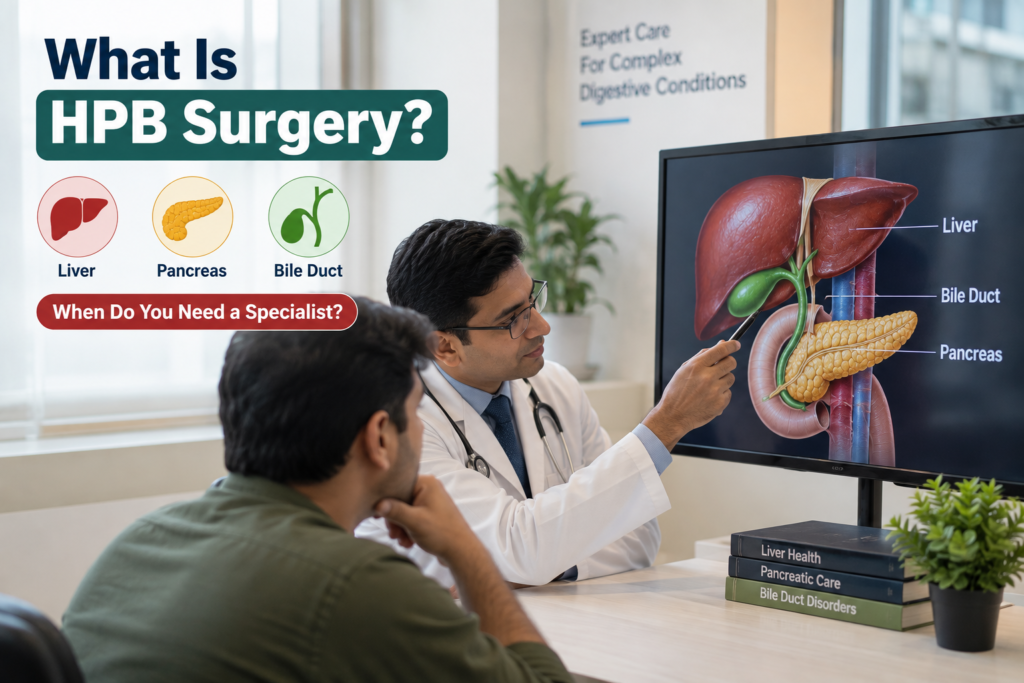
Table of Contents
What Is HPB Surgery?
The surgery for HPB includes liver surgery, pancreas surgery, gallbladder surgery and surgery of the bile ducts.
Bile is produced by the liver and it carries out a number of functions to aid in metabolism. The pancreas makes digestive enzymes and hormones, including insulin. The gall bladder stores bile and the bile ducts transport bile from the liver and gall bladder to the intestine.
Since these organs and tubes are all closely related, some surgeries will involve more than one.
For instance, a tumour at the head of the pancreas can also cause problems in the lower bile duct. In such an instance, the surgeon might have to remove and re-attach multiple structures in a single surgery.
It is therefore important to make a detailed diagnosis and careful surgical planning for HPB surgery. It is used in a few types of cancer, other tumours, cysts, pancreatitis, bile duct diseases and certain complicated conditions.
What Conditions Does HPB Surgery Treat?
If you are in doubt about what kind of liver, pancreatic and biliary diseases are treated at HPB surgery, the answer is quite broad.
Not all patients will need surgery. Your doctor will first be able to tell if surgery is needed and what kind of surgery is best.
Liver conditions
HPB surgery can relieve problems caused by:
- Liver cancer
- Some non-cancerous growths of the liver.
- Selected liver cysts
- Tumours that have spread to the liver (secondary liver tumours)
- Other focal liver lesions which require surgery
Liver resection is a procedure that is performed to remove the diseased part of the liver, while maintaining as much healthy liver tissue as possible. The amount removed depends on the location, size and number of lesions and the amount of healthy liver available.
Pancreatic conditions
Surgery is an option if:
- Pancreatic cancer
- Certain pancreatic cysts
- Some pancreatic tumours
- Chronic pancreatitis in individual patients
- Conditions other than diabetes which affect the pancreas and may need to have a section or all of the organ removed
Sometimes, pancreatic cysts aren’t cancer. Depending on their characteristics and risk, some cysts can be followed, and others may require additional testing or surgery.
Gallbladder conditions
Gallstones and other gallbladder issues are often treated with gallbladder surgery. In certain cases, gallbladder tumors or tumors in the surrounding bile ducts may require more complex HPB surgery.
Bile duct conditions
Other common conditions that HPB surgeons can treat are:
- Bile duct cancer
- Bile duct strictures
- Some of the bile duct injuries
- Impairment in bile drainage.
- Other complicated biliary diseases
Specialist centres also diagnose and treat benign and malignant diseases of the biliary system.
HPB Surgery for Liver Pancreas and Bile Duct Conditions
The liver, pancreas and bile ducts are independent organs but closely linked together.
This is the reason why, when performing liver pancreas surgery, it is important to have a full anatomical and diagnostic picture of the patient.
A tumour can be located near a large blood vessel, bile duct or other organ. A problem with the pancreas can impact the flow of bile. If a liver tumour is removed using a resection it may mean that a part of the liver is taken away, but still leave enough healthy liver.
Before recommending an operation, your surgeon uses imaging and other test results to learn about these relationships.
Removing the affected tissue is not the only objective. The surgical plan should also minimize the disruption of normal functions and the damage to healthy structures as much as possible.
How Are HPB Conditions Diagnosed?
There are several liver, pancreatic and bile duct diseases that may present the same symptoms. Different diseases may cause abdominal pain, nausea, changes in the digestive system, jaundice and unexplained weight loss.
Doctors thus take tests to determine the precise cause.
Evaluation may include:
- Blood tests
- Ultrasound
- CT scan
- MRI
- MRCP
- Endoscopic ultrasound
- ERCP
- Biopsy if indicated
- Other, more specialized imaging tests
Specialized diagnostic procedures enable doctors to understand diseases of the liver, bile ducts, and pancreas prior to treatment.
You may not need every test listed above. Your doctor will choose investigations based on your symptoms, medical history and initial findings.
A diagnosis also does not automatically mean that you need surgery. Some patients can be treated with medicines, endoscopic procedures, surveillance or other therapies.
What Are the Common Types of HPB Surgery?
The operation depends on the affected organ and the condition being treated.
Liver resection
Liver resection is the removal of a section of the liver harboring a tumour or other diseased area.
If part of the liver is removed, the liver can regenerate, but the surgeon will need to make sure that there is enough healthy liver to keep the function of the liver normal.
The size and location of the lesion determine the type of resection.
| HPB surgery | What it involves | Common reasons for surgery |
| Liver resection | Removes the diseased part of the liver | Selected liver tumours and lesions |
| Whipple procedure | Removes the head of the pancreas and nearby structures, followed by reconstruction | Selected tumours of the pancreatic head and nearby areas |
| Pancreatectomy | Removes part or all of the pancreas | Selected pancreatic tumours and other serious pancreatic conditions |
| Gallbladder removal | Removes the gallbladder | Gallstones and certain gallbladder diseases |
| Bile duct surgery | Removes or repairs affected bile ducts and restores bile drainage | Selected bile duct tumours, strictures and injuries |
Whipple procedure
One of the most important surgical procedures in HPB surgery is the Whipple procedure also known as pancreaticoduodenectomy surgery.
It is often used in some tumors of the head of the pancreas. It can also be used for some cancers in the lower bile duct or surrounding areas.
This may include removal of the head of the pancreas, a portion of the bile duct, the gallbladder, nearby lymph nodes and a portion of the small intestine. The digestive system is then built up again and food and digestive fluids can flow through the digestive tract.
Pancreatectomy
Pancreatectomy is the removal of a portion or the entire pancreas.
In a distal pancreatectomy, the body and tail of the pancreas are almost always removed. A complete pancreatectomy is done when the whole pancreas is taken out.
The surgery will vary depending on the site and severity of the disease.
Gallbladder surgery
Cholecystectomy (gallbladder removal) is often done to treat gallstones and some gallbladder diseases when the patient has symptoms.
The surgery to remove the gallbladder is simpler than the complex HPB surgery for gallbladder cancer or the disease of surrounding bile ducts.
Bile duct surgery
Bile duct surgery may include the removal of a diseased portion of the duct and reconstruction of the duct that drains bile into the intestine.
The procedure can be more complicated if there is a tumour, scar tissue or injury near the area to be operated on.
Detailed imaging and careful planning are especially critical during liver pancreas and bile duct surgery.
Open, Laparoscopic or Robotic HPB Surgery?
HPB operations can be performed through different surgical approaches.
Open surgery
Open surgery is performed with a bigger cut to provide the surgeon direct access to the affected area.
May be indicated for more complex operations or conditions when minimally invasive surgery is not indicated.
Laparoscopic surgery
Laparoscopic surgery involves the use of small incisions and a camera to enable the surgeon to work inside the abdomen.
Minimally invasive liver surgery may result in reduced pain, minimal incision and rapid recovery if the surgery is properly indicated for patients.
Robotic surgery
Another one of the minimally invasive surgeries is robotic surgery. Controlled by the surgeon from a console, the surgeon’s view of the operating area is displayed using a high-definition camera.
The robot does not perform the operation on its own. The surgeon controls every movement.
Not everyone is a suitable candidate for robotic surgery or laparoscopic surgery. It can depend on the disease, size and location of the tumour, prior surgery, anatomy and general fitness.
The best way is to proceed is to allow the surgeon to treat the disease adequately without harm to the healthy structures.
How Do Doctors Decide If You Need HPB Surgery?
Surgery is only one part of HPB treatment.
Your doctor may consider:
- Your exact diagnosis
- Size and location of a tumour or lesion
- Whether the disease has spread
- Involvement of nearby blood vessels or organs
- Liver and pancreatic function
- Your general health
- Previous treatments or operations
- Your nutritional status
- Whether another treatment could work instead
For some cancers, surgery may form one part of a larger treatment plan that also includes chemotherapy, radiation or other treatments.
Complex HPB care often involves multiple specialists. These may include surgeons, radiologists, oncologists, gastroenterologists, anaesthetists, pathologists and other healthcare professionals.
This team-based approach helps doctors assess the disease from different angles before finalising the treatment plan.
How Do You Prepare for HPB Surgery?
Preparation begins before you enter the operating room.
Your doctor or health care team might check your medications, blood tests, scans and overall health. A pre-operative assessment may also be performed to determine if you are fit for the surgery.
Your doctor may recommend you to take advice regarding:
- The timing of abstinence of food and fluids prior to surgery.
- Medications to continue or temporarily discontinue
- Smoking and drinking should be avoided.
- Blood sugar control
- Nutrition
- Physical activity
- Tests needed prior to admission
Don’t self-medicate. Follow your doctor’s instructions.
Good nutrition also matters, particularly before major abdominal surgery. If you have poor appetite, weight loss or another nutritional concern, tell your medical team.
What Happens After HPB Surgery?
Recovery is dependent on the procedure.
A minor surgical procedure for the pancreas or liver is not the same as a small surgery to remove a tumor.
Your healthcare providers may check:
- Pain
- Blood pressure and other vital signs.
- Wound healing
- Blood test results
- Bowel function
- Eating and drinking abilities; ability to inhale and exhale properly
- Blood sugars if applicable
- Remove the surgical drain if necessary to drain
Your team might pressure you to begin moving immediately when it’s safe. Your food plan may also change slowly as you recover.
A longer hospital stay and supervision may be needed for major HPB operations.
After discharge, follow your wound-care, medication, diet and activity instructions carefully. Follow-up visits to see the doctor to check progress and discuss further treatment if needed.
Patient information leaflets from the other large HPB centres also offer individual information on liver resection, pancreatic surgery, Whipple surgery, minimally invasive liver surgery and nutrition after pancreatic surgery.
What Warning Signs Should You Watch for After Surgery?
Some discomfort is expected after a major operation. However, certain symptoms need prompt medical attention.
Contact your medical team if you develop:
- Recurrent and/or increasing abdominal pain
- Fever that is high or doesn’t go down.
- Repeated vomiting
- Redness, swelling or discharge at the site of the wound.
- Jaundice (yellowing of the eyes or skin)
- Very tired or dizzy
- Difficulty breathing
- A problem with eating or drinking.
- Any sudden or unusual change that is of concern to you
Your surgeon will give you specific instructions because warning signs can vary depending on the procedure.
When to See an HPB Surgeon
Specialist evaluation should be considered if you have some type of problem with the liver, pancreas, gallbladder or bile ducts and your doctor thinks surgery may be needed.
Also, a specialist consultation may be warranted if imaging reveals:
- A tumor or suspicious growth in the liver
- A benign tumour or cyst in the pancreas.
- A bile duct tumour
- A complicated gallbladder disease
- An obstruction in the flow of bile.
- An abnormal state of an adjacent organ or blood vessel
- A condition that is unresponsive to prior treatment
It’s not a requirement that symptoms are severe. If scanners and/or diagnosis indicate that surgery might be required, an early specialist consultation will help you understand which options are available to you.
How to Choose an HPB Surgeon in Ahmedabad
HPB surgery may be a complicated process, involving large parts of the abdomen and/or complex anatomy. The surgeon’s experience, the support systems and services at the hospital, and the availability of appropriate diagnostic and post-operative care are important factors.
When you are looking for an HPB surgeon in Ahmedabad, look for one who takes time to explain the diagnosis and options you have for treatment.
In cases of liver, gallbladder or bile duct diseases, you might also need the services of a hepatobiliary surgery specialist in Ahmedabad.
Sometimes, you’ll also require a liver and pancreas surgery specialist if you have a complicated tumour, cyst, pancreatitis, or if there are issues with your blood vessels or bile ducts near the liver.
If a person has a condition that is causing the obstruction of the bile duct, bile duct strictures, injury or tumours, then it is best for them to consult a bile duct surgery expert in Ahmedabad to understand if surgery is necessary, and what may be appropriate.
The purpose of a specialist consultation is seldom to suggest surgery. It is to understand your condition properly and identify the most suitable treatment.
HPB Surgical Care at Harmony Hospital
We understand that a diagnosis involving the liver, pancreas or bile ducts can leave patients with many questions.
We start by revisiting your symptoms, medical history, investigation and diagnosis. This assists us when talking about treatment.
When surgery is necessary, we explain the surgery, why it is necessary, the approach, and recovery in layman’s terms. We also ask if you require extra specialist care either prior or after surgery.
We continue to take a proactive approach to communication and careful surgical planning and appropriate follow up during your treatment journey.
If you or a family member has been diagnosed with a liver, pancreatic, gallbladder or bile duct condition, speak with our team to understand what comes next.
The Right Treatment Starts With the Right Assessment
If you have a liver, pancreas or bile duct problem, then it does not necessarily require surgery. It is important to first understand what is causing the issue and the degree of the issue.
When surgery is needed, the surgery should be performed based on your condition, anatomy and overall health, rather than just on the availability of the surgery.
Feel free to ask questions about your diagnosis, treatment options, surgical approach, risks and recovery. Having a discussion with a seasoned surgery group can help you make informed choices and prepare for the treatment ahead.
At Harmony Hospital we want patients to know what to expect before they have treatment. We are here to help you understand your diagnosis, discuss your options with confidence and plan the next step.
Meet Our HPB Surgeon in Ahmedabad
Need expert advice for a liver, pancreas, gallbladder or bile duct problem? Consult Dr. Milind Kirit Akhani with 30+ robotic gastro onco surgeries, 15+ HPB onco surgeries at Harmony Hospital.
OPD: 5:30 PM to 7:00 PM (prior appointment required) Call: +91 95125 00822 / 44
FAQs:
Is HPB surgery only for cancer?
No. HPB surgery can be used to treat cancerous and non-cancerous diseases such as selected pancreatic cysts, chronic pancreatitis and some non-cancerous diseases of the liver.
Which organs does HPB surgery cover?
HPB surgery primarily includes surgery on the liver, pancreas, gallbladder, and bile ducts.
Is the Whipple procedure a type of HPB surgery?
Yes. The Whipple procedure is a big HPB surgery that is often performed on certain tumors affecting the head of the pancreas and surrounding tissues.
Does every pancreatic cyst need surgery?
No. The treatment depends on the type of cyst, and for some, no treatment is required except for observation. The choice of treatment will depend on the nature and characteristics of the cyst.
Is robotic HPB surgery suitable for everyone?
No. The procedure you have is determined by your disease, anatomy, previous treatment and overall health.
How long does HPB surgery recovery take?
The recovery is dependent on the procedure. A recovery timeline for a smaller minimally invasive surgery may be different from a larger surgery like a Whipple procedure or large liver resection.
When should I consult an HPB surgeon?
Consult an HPB surgeon when you have a liver, pancreas, gallbladder or bile duct condition that may require surgery, particularly when scans show a tumour, complex cyst, or obstruction.