A doctor recommending planned surgery does not automatically mean you must agree immediately. You have the right – and the time to understand why, ask questions, and confirm the decision is right for you.
Many patients think a surgical recommendation is the final word. In fact, planned surgery is often the start of a decision-making process, not the end. Doctors make surgical recommendations based on clinical judgment, evidence, and experience, but it’s your job to understand that recommendation in the context of your own health, risks, lifestyle, and priorities.
This guide will help you understand when to agree to a planned surgery that the doctor recommends, how to know if surgery is really necessary, and what questions to ask before a planned surgery so you can move forward with clarity instead of uncertainty.
This guide is for patients in India who are considering surgical options for the first time and for family members who are supporting them.
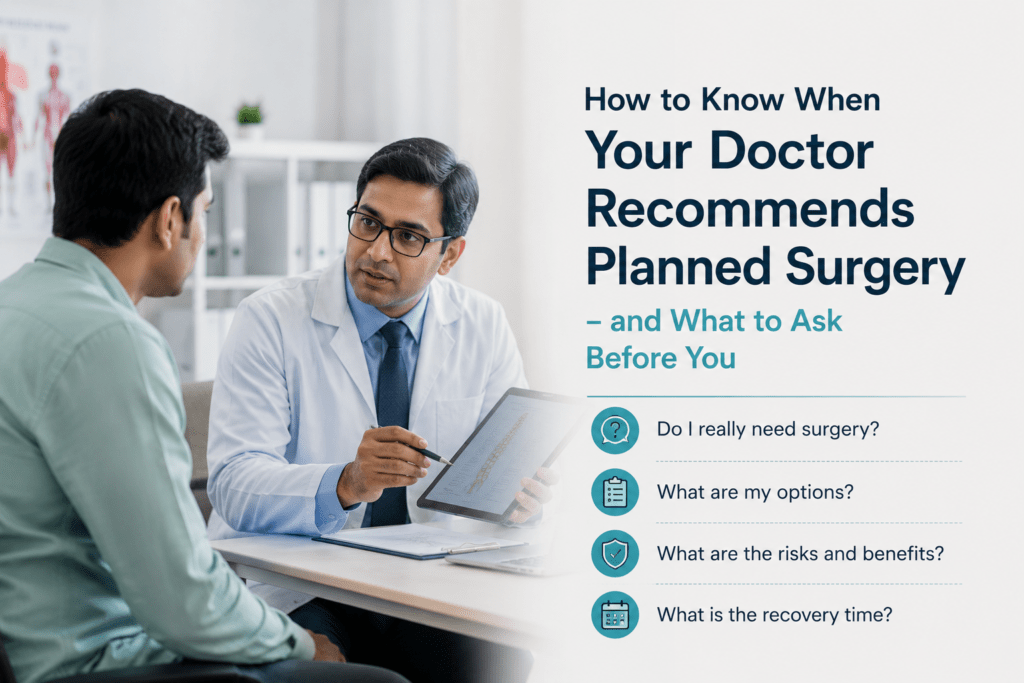
Table of Contents
What “Planned Surgery” Actually Means for You
Planned surgery is a surgical procedure that is scheduled, typically following diagnosis, medical assessment, and initial consultation. These are not urgent decisions to make, but they also are not decisions that you can always delay.
The word itself can be confusing to many patients. It implies there is some level of control and flexibility, but actually, it is frequently found somewhere in the middle between urgency and discretion.
Planned surgeries allow you time to understand your condition and make an informed choice, unlike emergency procedures that require immediate action, highlighting the importance of understanding planned surgery vs emergency surgery.
Planned Surgery Is Not Always Optional
The term “planned” often creates a false sense of flexibility. Patients assume that because the surgery is scheduled, it can be delayed indefinitely without consequences.
In reality, many planned surgeries exist in a grey zone:
- Not urgent today
- But not safe to ignore long-term
For example:
- A hernia may remain manageable, but it carries a risk of strangulation if untreated
- Gallstones may cause intermittent discomfort before leading to severe infection
- Joint damage may progress, making later surgery more complicated and recovery slower
So when evaluating how to tell if planned surgery is needed, the real question is:
“What are the consequences of waiting?”
In many cases, planned surgery is about preventing deterioration not just fixing an existing issue.
The Difference Between Recommended and Required
The word planned is used and can give the impression of flexibility. Patients think that since the surgery is planned, they can delay it or postpone it at any time.
In practice, there are numerous planned surgeries in the middle ground:
Not urgent today
Oftentimes, however, it is not safe to disregard long-term
For example:
- A hernia can be asymptomatic for months, but it can be prone to strangulation if left untreated.
- Gallstones can sometimes be painful, but can also cause no pain at all until they become infected or block a duct.
- As the damage to the joints progresses over time, additional surgery and recovery time may be required.
The difficulty comes from these situations because the dangers are not necessarily immediate, but they can be foreseen over a period of time.
The truth is, when considering whether surgery is necessary, it is not a question of “can I wait?” but:
What will happen if I don’t do it? What will be different if I do?
Many times, planned surgery is not just treating a problem; it’s preventing it from getting worse.
Timely action can lead to a more straightforward process, a quicker recovery, and the best possible outcome in the future. Putting off treatment for too long can make a manageable condition more complicated.
The knowledge of this balance is what will help you transition from uncertainty to an informed choice.
Why Timing Still Matters Even in Planned Cases
Even when surgery is not urgent, timing plays a critical role in outcomes.
Delaying too long can:
- Increase surgical complexity
- Extend recovery time
- Reduce the effectiveness of treatment
- Lead to avoidable complications
For instance, a smaller hernia is easier to repair than a large, complicated one. Similarly, early-stage joint issues respond better to intervention than advanced degeneration.
At the same time, immediate action without understanding the full picture can lead to anxiety, poor preparation, and unnecessary stress.
The focus should not be on speed, but on timing.
A well-timed decision considers:
- Medical urgency
- Current symptoms
- Risk of delay
- Personal readiness (physical, emotional, financial)
Signs the Surgery Recommendation Is Medically Solid
Some are well supported by evidence and clinical need. Others may be precautionary or based on physician preference.
Knowing the difference helps you recognize signs that the doctor is right about planned surgery.
Conservative Treatments Have Been Tried and Failed
Surgery is typically not the first line of treatment for most conditions.
Before recommending surgery, doctors usually try:
- Medications
- Physiotherapy
- Lifestyle changes
- Non-invasive procedures
If these approaches have been attempted and have not provided relief, surgery becomes a logical next step.
This progression is important because it shows:
- The condition is not responding to simpler treatments
- The recommendation is based on necessity, not convenience
If surgery is suggested early without exploring alternatives, it’s reasonable to ask:
“Have all non-surgical options been considered?”
This is often the first step in understanding what to ask when a doctor recommends surgery.
Diagnostic Tests Clearly Support the Recommendation
A medically sound recommendation is backed by objective evidence.
This includes:
- MRI or CT scans showing structural issues
- X-rays confirming degeneration or damage
- Blood tests indicating underlying conditions
- Endoscopy or biopsy findings
When your doctor explains the recommendation using these reports, it strengthens the credibility of the advice.
If the recommendation is based only on symptoms without supporting tests, it may not be complete.
This is one of the clearest ways to evaluate how to know if surgery is really necessary.
The Condition Is Causing Measurable Harm Right Now
If your condition is already affecting your health in measurable ways, delaying surgery may not be beneficial.
Examples include:
- Persistent pain affecting sleep or daily function
- Reduced mobility limits independence
- Recurrent infections
- Progressive organ dysfunction
In such situations, the cost of waiting may outweigh the risks of surgery.
Patients often ask: Is planned surgery necessary, or can I wait?
The answer depends on whether your condition is stable or actively worsening.
Your Surgeon Can Name the Goal, Not Just the Procedure
A strong surgical recommendation focuses on outcomes—not just the procedure.
Your surgeon should be able to clearly explain:
- What the surgery aims to fix
- What improvement can you expect
- What success looks like in your case
For example:
Instead of saying “We will perform a laparoscopic procedure,” the explanation should include:
“This will reduce your pain, prevent recurrence, and allow you to return to normal activity within X weeks.”
If the explanation is vague or overly technical without addressing outcomes, you need more clarity.
When It Is Reasonable to Wait Before Deciding?
For most planned surgeries, the decision is not immediate. You are not deciding on either surgery or no surgery, but rather when to have surgery.
Knowing when it is OK to wait will allow you to avoid unnecessary pressure and will help you to make a decision that is both medically appropriate and personally comfortable. This stage is where many patients really get an understanding of when a planned surgery may be necessary, and not just take the word of the doctor.
Your Symptoms Are Stable and Not Getting Worse
If your condition is not progressing, you may have time to step back and evaluate your options carefully.
Indicators include:
- Pain levels are consistent and manageable
- No new symptoms have developed
- Your daily routine is not significantly affected
In such situations, your condition is relatively stable, which gives you space to think beyond the immediate recommendation.
This allows you to:
- Seek a second opinion
- Understand all available treatment options
- Prepare physically, mentally, and financially if surgery becomes necessary
Waiting in these cases is not a delay in care; it is a structured and informed approach to decision-making.
You Have Not Been Told the Risk of Waiting
If your doctor has not clearly explained what happens if you delay surgery, you are missing a critical part of the decision.
Ask directly:
- Can I delay planned surgery safely?
- What risks increase if I wait?
- At what point does this become urgent?
A good surgeon will give you:
- A realistic timeframe within which it is safe to decide
- Clear warning signs that indicate the condition is worsening
- Guidance on when immediate action is necessary
Without this information, it becomes difficult to weigh your options properly. Knowing the consequences of waiting is just as important as understanding the benefits of surgery.
Non-Surgical Options Have Not Been Fully Explored
It is important to have a conversation about alternatives to surgery if surgery is being recommended during the early stages of discussion.
Clearly understand that:
What are the alternative treatment options to surgery?
Do they work well for your health problem?
Why they may or may not be suitable for you.
If none of the alternatives is likely to be effective, your doctor will tell you why. This increases confidence in the recommendation, and it makes you feel part of the recommendation.
This is an important aspect of any orchestrated surgical decision-making process in India, where treatment options may differ due to availability, cost, and patient choice.
Patients often consent to surgery because they didn’t know what else was available. By taking the time to explore these possibilities, you can make sure that the choice is one made based on understanding, rather than assumption.
15 Questions to Ask Your Surgeon Before You Agree
Knowing what to ask before agreeing to an operation is one of the most powerful tools you have.
These questions are structured to cover every aspect of your decision.
4 Questions About Why Surgery Is Being Recommended
- Why do I need this surgery now?
- What happens if I don’t have the surgery?
- Are there effective non-surgical alternatives?
- Is this the standard treatment for my condition?
These help you understand how to know if surgery is really necessary.
4 Questions About the Procedure Itself
- What exactly will be done during the surgery?
- Is this open surgery or minimally invasive?
- How long will the procedure take?
- What type of anesthesia will be used?
These questions reduce uncertainty and help you mentally prepare.
4 Questions About Risks and Recovery
- What are the common and serious risks?
- What is the expected recovery timeline?
- When can I return to normal activities or work?
- Will I need physiotherapy or follow-up care?
These are essential questions to ask a surgeon before agreeing to operate.
3 Questions About Cost, Insurance, and Logistics
- What is the total estimated cost?
- What is covered by insurance?
- How long will I need to stay in the hospital?
Financial clarity is a critical part of decision-making.
Knowing how to prepare questions for a surgeon consultation ensures you leave with confidence, not confusion.
How to Get a Second Opinion Without Offending Your Doctor?
Many patients hesitate to seek another opinion, worrying it may offend their doctor. In reality, it is a standard and accepted part of healthcare.
Second Opinions Are a Recognised Patient Right
Seeking a second opinion before elective surgery in India is a common practice.
It helps you:
- Confirm the diagnosis
- Explore alternative treatments
- Gain confidence in your decision
Most experienced doctors respect and encourage this.
Where to Seek a Second Opinion in India?
You can approach:
- Another specialist in the same hospital
- A different hospital or clinic
- A senior consultant with extensive experience
Choose someone with expertise in your specific condition.
What to Carry When You Go for a Second Opinion?
To ensure accurate advice, carry:
- All diagnostic reports
- Prescriptions and treatment history
- Doctor notes and summaries
This avoids repetition and ensures informed evaluation.
Warning Signs to Watch for Before Agreeing
In most cases, surgical treatments may be recommended for a person’s benefit; however, there are instances where you should stop and look carefully. While these signs are not necessarily indicators of the incorrectness of the advice, it does indicate that further clarity needs to be obtained before initiating action.
The Consultation Felt Rushed or Incomplete
If your consultation felt hurried or you didn’t get enough time to ask questions, it’s worth slowing down. Surgery is a major decision, and you should never feel like you’re being pushed toward a quick “yes.”
A good consultation should leave you with a clear understanding of your condition, the reason for surgery, and what to expect next. If you walked away confused or unsure, consider scheduling a follow-up or seeking another opinion before deciding.
No Alternative Treatment Was Ever Discussed
When surgery is offered without mention of any other treatment, you might not have all the answers. Depending on the condition, there are treatments that do not involve surgery or are less invasive, which may be tried first.
Your doctor should tell you why those options are not right for you. It’s crucial to know what has been excluded and why when evaluating an informed choice.
The Recommendation Is Based Only on Symptoms, Not Tests
A strong surgical recommendation is usually supported by a combination of symptoms, clinical evaluation, and diagnostic evidence. Tests such as scans, blood work, or imaging help confirm the exact nature and severity of the condition.
If surgery is suggested without clear diagnostic backing, it’s reasonable to ask whether further evaluation is needed. This ensures that the decision is based on objective findings, not just symptoms that could have multiple causes.
Final Guidance – Your Decision, Your Timing
The decision to recommend surgery by a qualified surgeon should be taken seriously and carefully considered.
As for when one should consent to the doctor’s advice to undergo planned surgery, it’s about being informed, not just accepting an opinion.
The questions you ask before your operation are as important as the operation itself. A patient with a clear understanding of their surgery and recovery is less likely to experience shocks.
Making informed healthcare decisions requires taking time to evaluate, asking the right questions, and seeking clarity.
Patients with questions in hand are welcomed by the surgical teams at Harmony Hospital, ranging from the general surgery team to the laparoscopic team, the orthopaedics team, the urology team, and others. That is the way that good surgical decisions are made.
FAQs:
-
What questions should I ask my doctor before planned surgery?
Start by asking why the surgery is being recommended and whether there are non-surgical alternatives you should consider. You should also understand what happens if you delay or avoid the procedure for now. Ask about how the surgery will be performed, the risks involved, and the expected recovery timeline. Finally, clarify costs, hospital stay, and follow-up care so you are fully prepared before making a decision.
-
How do I know if a surgery recommendation is really necessary?
A surgery is more likely to be necessary when it is supported by diagnostic tests and when non-surgical treatments have not worked. You should also consider whether your condition is affecting your daily life or worsening over time. A clear explanation from your doctor about the expected outcome of surgery is a strong indicator of necessity. If the reasoning feels unclear or incomplete, it’s worth asking more questions or seeking another opinion.
-
Is it okay to get a second opinion before surgery in India?
Yes, getting a second opinion is completely normal and often recommended for planned surgeries. It helps confirm the diagnosis and gives you a broader understanding of your treatment options. Most doctors respect this decision and do not see it as a lack of trust. Carrying your reports and medical history ensures the second consultation is efficient and accurate.
-
What does a surgical consent form mean, and should I read it?
A surgical consent form is an acknowledgement that you understand the procedure, the risks, and the expected outcomes. It is not just a routine form to sign but a significant part of informed decision-making. Read it carefully and ask for clarification on anything you do not understand. It is not on assumption but full knowledge that it is being signed.
-
Can planned surgery become an emergency if I wait too long?
Sometimes, waiting to have surgery can cause complications that need to be treated right away. Untreated, conditions such as hernias or gallstones can get worse. This risk is related to your specific condition and course. So it’s important to talk with your doctor about what the implications of waiting might be.
-
What are my rights as a patient before undergoing surgery in India?
You are entitled to know your condition and the procedures to be done on you. You are entitled to question the doctors about these matters and even to request for another doctor to examine you. Moreover, you have the right to make an informed decision regarding the procedures that you are subjected to only when all the information is laid bare for you.