
Noticing visible veins on your legs may certainly strike some questions in your mind. Is it a harmless spider vein or is it a varicose vein that needs medical attention. The difference matters a great deal. They look similar but have completely different meanings.
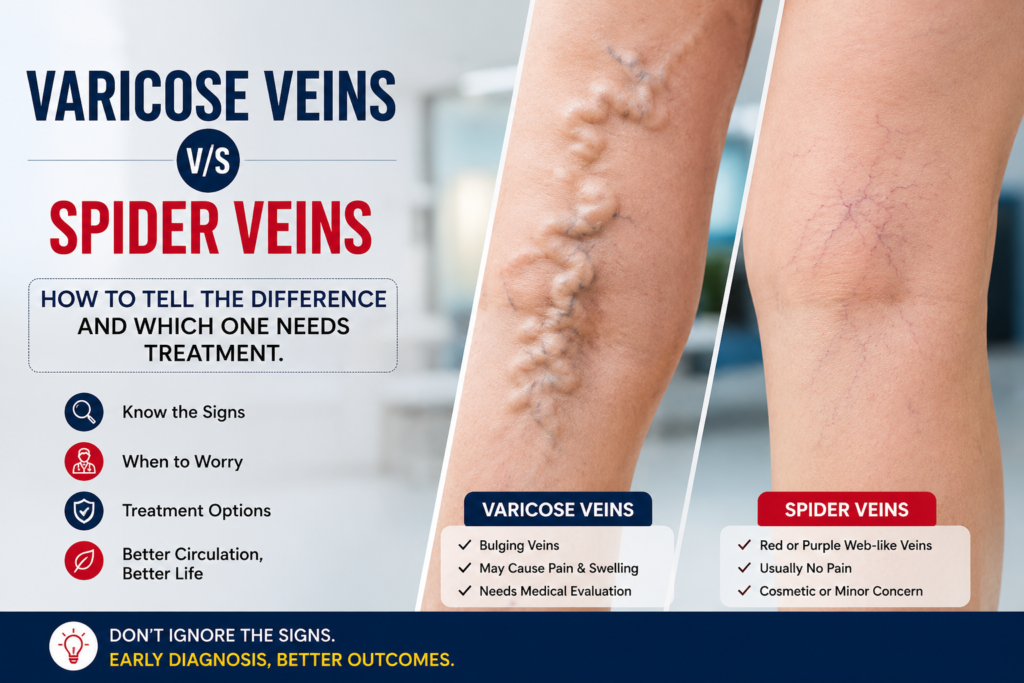
Spider veins are small, thin and web-like veins that usually stay close to the skin and rarely cause symptoms. Varicose veins are larger, twisted or bulging veins that can cause pain, heaviness, swelling and other signs of poor vein function. Approximately 2-73% of the global population suffers from varicose veins.
The appearance of the vein is not the only factor deciding the type of vein issue. A vein that looks minor can sometimes cause symptoms, while a prominent vein may cause little or no discomfort. Knowing the key differences between spider veins and varicose veins can help you understand what you are seeing, what symptoms to watch for and when it is time to get a medical evaluation.
This guide explains the key differences between varicose and spider veins, their causes, symptoms, risk factors, diagnosis, treatment options, prevention, when to seek medical care, and how common these conditions are in India.
Table of Contents
Varicose Veins vs Spider Veins: At a Glance
| Feature | Spider Veins | Varicose Veins |
| Size | Small and thin | Larger and more prominent |
| Appearance | Web-like, branching or thread-like | Bulging, twisted or rope-like |
| Colour | Usually red, blue or purple | Usually blue, purple or skin-coloured |
| Location | Very close to the skin’s surface | Usually involve larger superficial veins |
| Raised from skin | Usually flat | Often raised or bulging |
| Symptoms | Usually none, although mild discomfort can occur | May cause aching, heaviness, swelling, itching, burning or cramps |
| Main concern | Often cosmetic | May be cosmetic or related to venous disease |
| Common treatment | Sclerotherapy or laser treatment when desired | Lifestyle measures, compression and minimally invasive procedures when indicated |
| Need for treatment | Usually optional if there are no symptoms | Depends on symptoms, severity and underlying venous reflux |
Both conditions have visible veins, but they aren’t exactly the same. These variations in size and appearance, as well as symptoms and underlying cause, can also impact whether treatment is required. Before discussing when medical care might be indicated, let’s examine each condition individually.
What are Varicose Veins?
Varicose veins are veins that are enlarged, swollen and tortuous, typically found in the veins of the legs. They are raised above the surface of the skin and can be blue or purple in color.
The cause of varicose veins can be venous reflux, which occurs when the one-way valve inside the veins does not function as it should.
Normally, the veins in the legs carry blood back towards the heart. These veins are assisted to keep the blood moving in the correct direction by the valves and the compression of the leg muscles as they move against gravity.
As the valves weaken or break down, blood may flow into the veins, leading to pooling in the veins. This added stress places strains on the veins that may enlarge and turn varicose.
This is why varicose veins can sometimes be more than an appearance issue.
What are Spider Veins?
Spider veins are small, visible blood vessels that are close to the skin. They can create patterns resembling spider web, branches or thin threads. They are found most often on the legs, but can be found elsewhere on the body.
They can be red, blue or purple, and are typically not raised.
Spider veins are typically not an indicator of serious disease but rather a cosmetic problem. May not have any symptoms. If symptoms do occur, some may experience mild aching, burning or discomfort around the affected area.
Some of the causes of spider veins are:
- Ageing
- Family history
- Hormonal changes
- Pregnancy
- Sitting or standing for extended periods of time
- Weight gain
- Excessive exposure to the sun (facial spider veins)
Telangiectasias are sometimes referred to as spider veins. Telangiectasias and reticular veins are an early visible phase of venous disease in the clinical classification of chronic venous disease. But just the sight of the spider veins does not necessarily indicate that a person has a major venous insufficiency.
What Do Spider Veins Look Like?
Spider veins commonly look like:
- Fine red, blue or purple lines
- Small branching veins
- Web-like patterns
- Thread-like veins
- Flat marks beneath the skin
What Do Varicose Veins Look Like?
Varicose veins commonly look like:
- Bulging veins
- Twisted veins
- Enlarged blue or purple veins
- Rope-like veins
- Raised veins beneath the skin
Skin colour can affect how visible these changes are. This means that appearance alone should not be used to determine how serious a vein condition is.
What Symptoms Can Varicose Veins Cause?
Varicose veins may be asymptomatic. Some things can impact comfort and functionality.
Common varicose vein signs and symptoms include:
- Leg pain or aching leg
- A feeling of heaviness or tiredness
- Bulges around the ankles or legs
- Rubbing around the affected veins
- Burning or throbbing
- Nighttime leg cramps
- Skin colour changes
- Dryness of skin around the lower leg or irritation of the skin.
Symptoms can worsen when standing or sitting for extended periods of time. Resting or raising the legs may help relieve stress.
If symptoms persist, it should not be written off as a cosmetic problem.
What Symptoms Can Spider Veins Cause?
Spider veins usually don’t cause symptoms and are primarily a cosmetic problem. But for some, the discomfort may be mild, especially if spider veins are in combination with varicose veins or any other underlying blood flow issue. Possible symptoms include:
- Burning/warmth around affected area
- Itching
- Mild aching or pain
- Knee pain, fatigue or soreness.
- Cramping
The symptoms do not necessarily originate with the spider veins. At times they can refer to a venous disease like chronic venous insufficiency. If the spider veins are visible and the leg has also been painful, swollen, heavy or changed in some way that persists, a diagnosis can be made to help determine the cause of the spider veins.
Can You Have Spider Veins and Varicose Veins Together?
Yes.
Spider veins, reticular veins and varicose veins can all occur simultaneously. These are various forms of venous disease.
For instance, you might see tiny spider veins at the knee or thigh and larger raised varicose veins lower down the leg.
This is why it is always better not to diagnose yourself from just the look of it. When visible veins are associated with pain, swelling, heaviness and/or skin changes, a medical evaluation can help to determine if there is an underlying circulation problem.
Varicose Veins vs Spider Veins: What Is the Difference?
The best means of distinguishing them is by size, shape, depth and symptoms.
Spider veins tend to be smaller, flatter and closer to the surface. They tend to have a web-like arrangement and are typically not associated with any symptoms.
Varicose veins are bigger and can be elevated, twisted or rope-like. They tend to produce symptoms including aching, heaviness, swelling, itching, burning or nighttime leg cramps. Symptoms may get worse when sitting or standing for long periods of time and may improve when the legs are raised.
They also have a different medical importance. Typically, spider veins are treated for cosmetic reasons only. Varicose veins (especially if symptomatic) may be a sign of underlying venous insufficiency and should be evaluated.
Are Spider Veins a Sign of Venous Insufficiency?
Not necessarily.
Spider veins typically are not a serious condition and frequently treated when a person does not like the appearance. But they can sometimes happen in conjunction with other venous diseases.
The key is to consider the overall clinical picture.
For those who have spider veins but are not experiencing pain, swelling, heaviness, skin changes or other symptoms, the treatment might be cosmetic only.
If veins are seen with persistent swelling, aching, heaviness or changes in skin appearance or other symptoms, further evaluation may be recommended to determine if there is an underlying venous problem.
This is relevant because it is important to treat a visible vein without discovering the source of the patient’s venous reflux, a distinction that is important to make because treating just a vein may not solve the problem.
What Causes Varicose and Spider Veins?
There are some common risk factors for both conditions, and the changes may be different for each condition.
Poor or faulty vein valves
In healthy valves, blood is directed towards the heart. If such valves weaken, the blood can flow back and collect in the veins. It’s a crucial process in many of the varicella and chronic venous insufficiency.
Ageing
As a person ages, the efficiency of the vein walls and valves may decrease. This makes veins more visible and makes vein problems more likely.
Family history
History of varicose or spider veins in the family.
Hormonal changes and pregnancy
During pregnancy, the blood volume expands and there is added pressure on the veins. Changes in hormones can also impact on the walls of the veins.
Sitting or standing for long periods of time
Those who stand or sit for long periods of time may be at higher risk of developing symptoms because blood may pool in the legs and feet.
Weight
The more weight that a person has, the more pressure on the veins, and this can cause a venous problem.
Reduced physical activity
The calf muscles act as a pump that helps move blood back towards the heart. Walking and movement will help the veins to circulate.
How Are Varicose Veins and Spider Veins Diagnosed?
Diagnosis typically starts with a physical exam, along with a discussion of symptoms, medical and family history, and lifestyle.
If you have varicose veins, your legs may be checked while you are standing, as this will help to expose the condition and swelling.
A Doppler or duplex ultrasound may be ordered when a diagnosis of varicose veins or venous insufficiency is suspected.
A non-invasive test that measures the flow of blood in the veins with sound waves. Can be used to assess abnormal blood flows, valve issues and venous reflux. A Doppler ultrasound can also be used to identify blood clots, when clinically appropriate.
It is essential to have a proper diagnosis since treatment should be aimed at the underlying cause and severity of the vein, not just seeing the vein.
When Should You See a Doctor for Varicose or Spider Veins?
If there are visible veins, medical evaluation should be considered if these are accompanied by:
- Ongoing pain or dullness in the pain.
- Weight of legs which interferes with activities of daily living
- Swelling of legs or ankles
- Itching or burning
- Changes in skin colour or texture.
- Sores or ulcers around the ankle.
- A ruptured varicella vein causing a bleeding disorder.
- A sudden onset of worsening symptoms.
- Tenderness, warmth or significant redness
If a varicose vein is bleeding, it is extremely important that you get medical help as soon as possible. It is recommended you get medical attention right away if your varicose veins start to bleed and see a health care professional if a vein suddenly becomes more bothersome or develops an ulcer.
A visible vein might appear insignificant on the outside, but there could be an underlying venous issue. This is the reason why ongoing or worsening symptoms should be evaluated.
Which One Needs Treatment: Spider Veins or Varicose Veins?
The solutions may be different for different people.
Usually, spider veins don’t require treatment.
The initial treatment may not be necessary if spider veins are not causing symptoms and may be pursued primarily for cosmetic purposes.
Some common therapies include:
- Sclerotherapy – A solution is injected into the vein to close it and make it disappear.
- Laser treatment – Laser energy can treat small visible vessels without using a sclerosing agent.
A medical examination may be indicated, however, when there are symptoms or other indications of venous disease associated with spider veins.
Sometimes varicose veins require treatment if they cause symptoms or complications.
Treatment is dependent on the severity, the veins involved and whether venous reflux exists. If necessary, a duplex ultrasound can be used to determine the cause of the blood flow abnormality and help direct treatment. The current recommendations of the Society for Vascular Surgery recommend endovenous ablation over vein stripping for patients with symptomatic varicose veins where there is axial reflux.
Varicose vein treatment options include:
There are lifestyle measures, and symptom management.
Walking regularly, avoiding sitting or standing for too long, leg elevation and weight control may help with circulation and reduce the symptoms. These measures can help increase comfort, but are not likely to cure existing varicose veins.
Compression therapy
For some patients, compression stockings can be effective in decreasing symptoms of swelling, aching and heaviness. These act to control symptoms, but not specifically to cure the defective vein valves or reflux itself.
Sclerotherapy
Sclerotherapy is a technique of injecting a solution into the affected vein and making it close and fade over time. Commonly used for spider veins, reticular veins and selected smaller varicose veins/tributaries. Presently, the treatment of sclerotherapy is recommended for symptomatic telangiectasias and reticular veins and is recommended for appropriate symptomatic varicose tributaries.
Endovenous laser treatment (EVLT/EVLA)
EVLT involves the use of a thin tube (laser catheter) that is inserted into the vein and laser energy is used to close the vein from the inside. A minimally-invasive treatment for patients with symptomatic varicose veins and venous reflux who are considered appropriate. Endovenous ablation should be considered for proper patients with axial reflux who present with symptoms.
Radiofrequency ablation (RFA)
Radiofrequency ablation involves treatment with controlled heat through a catheter to seal the refluxing vein. It is performed on selected patients with varicose veins with abnormal superficial venous reflux and symptoms. Thermal and non-thermal ablation are selected based on the anatomy of the veins, the clinical findings, expertise available, and patient preference.
Phlebectomy
Ambulatory phlebectomy involves extracting varicose tributaries with very small incisions in the skin. It can be used as monotherapy for appropriate varicosities on the surface or in combination with treatment of refluxing vein. Vascular guidelines suggest that the treatment of choice for symptomatic varicose tributaries is miniphlebectomy or ultrasound guided sclerotherapy.
Traditional vein surgery
Ligation and stripping is a procedure of tying off and cutting off the affected vein. They are not often used as the first option when minimally invasive endovenous treatment can be performed, but may be considered if the vein anatomy is not appropriate for endovenous treatment, or the technology or expertise is not available.
It may include:
The aim is not just to blend the veins out of view. Treatment can focus on symptoms relief, better blood flow, stopping symptoms from getting worse and decreasing the chances of complications.
Can Varicose Veins Be Treated Without Surgery?
Yes. For many varicose vein sufferers, surgical options can be avoided and instead, minimally invasive treatments may be used.
Endovenous ablation involves closing an abnormal vein with either laser or radiofrequency energy through the use of a catheter. Blood is then rerouted through healthier veins.
Other procedures are available depending on the size, location and cause of the varicose veins, such as sclerotherapy and ambulatory phlebectomy. Larger varicose veins may be treated with a radiofrequency or laser procedure through a small incision, while the more superficial varicose veins may be treated by phlebectomy, which involves extracting them through small skin incisions, notes Mayo Clinic.
In selected cases, especially if more conservative therapies are not indicated, conventional vein ligation and stripping may still be indicated.
Treatment should therefore be based on the clinical picture, and not on the veins alone.
Can You Prevent Varicose and Spider Veins?
It’s just not possible to avoid all cases; for instance, there are factors like age, genetics and pregnancy that cannot be changed. But there are some habits that can help promote good blood flow and may help minimize symptoms or the chances of worsening.
Stay physically active
Walking and other suitable forms of exercise encourage the calf muscles to contract. This will encourage blood to flow into the heart and discourage leg pooling.
Do not sit or stand for extended periods of time
Avoid sitting or standing for long periods if it is necessary, move around frequently and get brief movement breaks.
Elevate your legs
When lying down, elevate legs to relieve pressure in the veins and to help reduce swelling and heaviness.
Comply with weight maintenance guidelines
Extra weight may put strain on the veins. Supporting circulation and overall vascular health with a healthy weight is important.
Use compression only when advised
Some people may be able to manage their symptoms of swelling, pain and heaviness with compression stockings. They are not suitable for all people, however, they should be chosen with proper medical advice. Usually, compression therapy helps to manage symptoms, but does not fix the reflux issue.
Varicose Veins and Spider Veins in India: How Common Are They?
The prevalence of varicose veins in India is not easy to determine but they are not uncommon.
There is much variation in the rate reported in different Indian studies, as they have included different populations, geographic areas, age groups and occupational groups and have employed different methodology.
For instance, a recent community based study on 1151 rural adults in Tamil Nadu revealed that 7.2% of them had chronic venous disorders. Varicose veins took up 4.5% and telangiectasias (which include spider veins) 2.1%. They also identified links between weight and BMI with chronic venous disorders.
Higher frequencies have been reported in other Indian studies, particularly in certain population groups. The prevalence of varicose veins was 46.7% among women and 27.8% among men in a study of adults in northern India. The important risk factors that were found were family history and age.
These numbers do not represent a single national prevalence number. They demonstrate why there can be different estimates for Indian studies.
In India, occupational factors also play a role. Long-standing and heavy work have been studied over and over as possible risk factors. A large study in the north of India showed a strong link between extended standing and varicose veins and hospital-based studies in India have also demonstrated that varicose veins were a significant problem in working-age adults.
The bottom line is that none of the percentages is as significant as the practical one – varicose veins are a relevant vascular health issue in India and should not be treated as something that one ignores because visible veins are common.
Why Early Evaluation Matters
Varicose veins don’t necessarily lead to complications. Symptoms, however, may worsen and chronic venous disease may cause skin changes and, in more severe cases, venous ulcers.
Varicose veins that are not treated or that worsen can cause bleeding or ulcers.
This is not to say that all varicose veins require a procedure.
It implies that the decision is to be made on the basis of:
- Your symptoms
- The size and position of veins
- If the reflux is present or not
- Skin changes
- Any history of complications
- Your overall health
- Your treatment goals
An adequate vascular examination will help decide if monitoring, lifestyle modification or compression or intervention is indicated.
The Bottom Line
Varicose veins and spider veins have more in common than just their appearance.
Spider veins are usually smaller, flatter and harmless. They may only require treatment if a person wishes to make an important change in their appearance. Varicose veins are larger and more likely to cause symptoms like aching, heaviness, swelling or itching. In some cases, they may be a symptom of a venous valve and blood flow issue.
Don’t be afraid each time you see a visible vein. But you should not ignore persistent pain, swelling, skin changes, bleeding or other worsening symptoms either.
As a part of the cardiology and surgical services at Harmony Hospital, Ahmedabad, patients can benefit from multidisciplinary medical and surgical services, diagnostic services, and vascular expertise. We put a strong focus on individual evaluation to ensure that care is tailored to the patient’s specific needs and circumstances, not just their symptoms.
When you’re not sure if the veins on your legs are spider veins or varicose veins, a medical examination will help you determine the correct diagnosis. The first step towards treating visible veins is finding out what is causing them.
Also Read: Varicose Veins Treatment: Laser Surgery vs Traditional Surgery: Which Is Better?
-
What is the main difference between varicose veins and spider veins?
Spider veins are small, thin and are typically flat, while varicose veins are larger, raised and twisted. Varicose veins also tend to cause symptoms and venous reflux.
-
Do spider veins pose a threat?
The majority of spider veins are not a medical concern and do not cause any harm. If they are painful, swollen, heavy or have skin changes, your doctor might recommend medical evaluation.
-
Can spider veins turn into varicose veins?
Spider veins are not just varicose veins. Occasionally, patients with underlying venous insufficiency may have both conditions.
-
Is it necessary to treat varicose veins?
No, if the varicella is present but not causing symptoms, then it may require monitoring only and healthy lifestyle recommendations. Persistent symptoms, complications, skin changes or significant venous reflux may warrant treatment.
-
Do varicella fade away?
Once established, varicose veins tend to persist. Persistent or symptomatic veins may require medical treatment, but lifestyle treatments can help alleviate symptoms.
-
Do varicose veins require Doppler ultrasound?
All visible veins do not need ultrasound. If a varicose vein is causing symptoms, Doppler or duplex ultrasound may be recommended to evaluate the blood flow and valve function/venous reflux.
-
What’s the best treatment for spider veins and varicose veins?
There is no one right treatment. Sclerotherapy or laser treatment can be recommended to treat spider veins, and compression, endovenous ablation, sclerotherapy or phlebectomy may be indicated for varicose veins. A vascular evaluation is used to find the best choice.