
Robotic and laparoscopic surgery have changed the way many gastrointestinal conditions are treated. Both use small incisions instead of one large abdominal cut. Both can reduce tissue damage compared with open surgery. But they are not the same technique.
The key difference between robotic surgery and laparoscopic surgery is how the surgeon operates the robotic instruments and views the operating area.
Robotic surgery gives the surgeon a 3D view and articulated instruments that can make precise movements inside the body. Laparoscopic surgery uses long, straight instruments controlled directly by the surgeon.
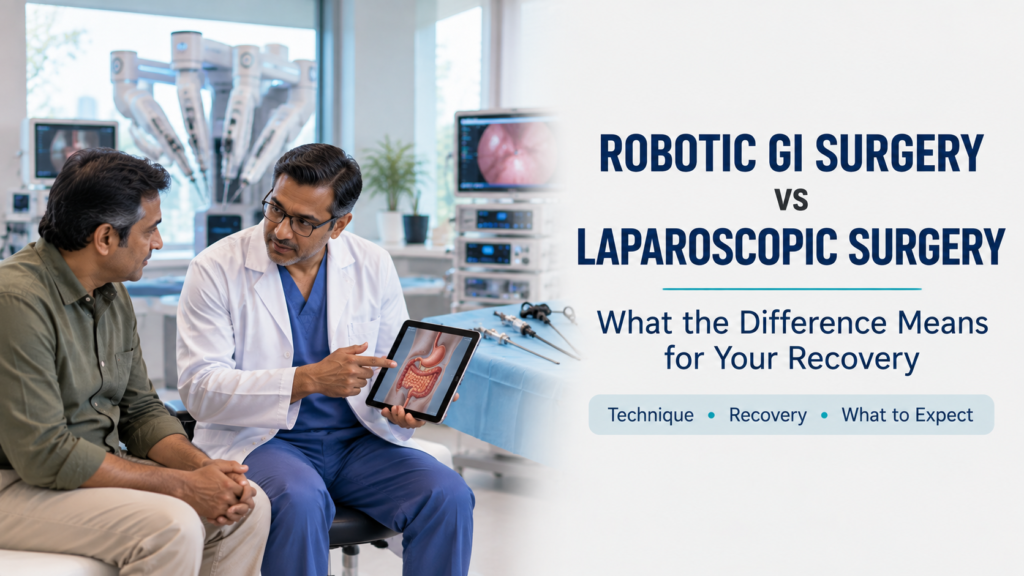
Table of Contents
So, is robotic GI surgery better than laparoscopic surgery?
There is no one right or wrong answer. The right approach will vary depending on the nature and complexity of the surgery, the patient’s health, and the surgeon’s expertise.
Robotic vs Laparoscopic GI Surgery: Key Points
| Factor | Robotic GI Surgery | Laparoscopic GI Surgery |
| Surgical approach | Surgeon controls robotic instruments through a console | Surgeon directly controls laparoscopic instruments |
| Incisions | Small incisions | Small incisions |
| Visualisation | Magnified 3D view | Magnified camera view |
| Instrument movement | Flexible, articulated instruments with a wider range of motion | Straight instruments with more limited movement |
| Surgical precision | Allows precise movements in confined spaces | Provides good control for many GI procedures |
| Operating time | May take longer for some procedures | Often shorter in comparative studies |
| Blood loss | Generally similar to laparoscopy in broad GI evidence | Generally similar to robotic surgery |
| Hospital stay | Often similar to laparoscopy | Often similar to robotic surgery |
| Recovery | Recovery depends mainly on the type and complexity of surgery | Recovery depends mainly on the type and complexity of surgery |
| Conversion to open surgery | May be lower in selected procedures | May be higher in some selected procedures. |
| Cost | Usually higher | Usually lower |
| Best suited for | Selected complex procedures where enhanced dexterity and visualisation may help | Many routine and complex GI procedures where laparoscopy is suitable |
Evidence from randomised trials shows that many outcomes are similar between the two approaches. A systematic review of 45 randomised studies involving 7,364 patients found no significant difference in mortality in the studies reviewed. Most studies also did not report any significant differences in complications, hospital stay or conversion to open surgery. An advantage of laparoscopic surgery was that it often took less time and cost less.
What Is the Difference Between Robotic and Laparoscopic Surgery?
Both techniques are minimally invasive. The main difference is how the surgeon operates.
In laparoscopic surgery, the surgeon uses a camera and special instruments through small incisions in the abdomen. The surgeon observes the surgical field on a screen and controls the instruments directly.
In the case of robotic surgery, a surgeon would sit at a console and operate the manipulators. The system dictates these hand movements to precise movements of the instrument within the patient. Robotic technology can also offer magnified 3D visualisation of the area and instruments that are more flexible.
This can assist when performing procedures on difficult angles or in narrow areas or intricate suturing.
However, the robot cannot carry out the operation by itself. Surgeon always in control during the procedure.
What does the evidence say about Robotic GI Surgery vs Laparoscopic?
There is not enough evidence to suggest that robotic surgery is superior in all gastrointestinal surgeries.
A systematic review of 18 randomized controlled trials revealed comparable results for several of the outcomes between the two groups, including blood loss, mortality, hospital stay, postoperative pain, postoperative readmission, and anastomotic leakage for GI surgery performed using the robot compared to the laparoscope. There was a lower conversion rate to open surgery and a quicker return of bowel movement with robotic surgery in the review. The robotic procedures were also longer and more expensive.
That distinction matters.
In some surgeries, there could be technical advantages with robotic surgery. In many patients, laparoscopy is a very successful minimally invasive procedure.
The best should be determined by the procedure, patient and surgical team, and not technology per se.
What Are the Advantages of Robotic GI Surgery?
To overcome some of the drawbacks of traditional laparoscopy, robotic systems have been created.
Greater instrument movement
Robotic tools allow the device to bend and rotate within the body. This provides the surgeon with a greater degree of freedom when performing precise movements.
3D magnified vision
The robotic system can give a magnified 3-D view of the surgical field. This can facilitate the surgeon’s identification of anatomical structures and operations in limited spaces.
Precise movements
The system provides for translating the surgeon’s hand motion into controlled motion of the instruments. It can also filter natural hand tremors.
Potential benefit in complex procedures
The features can be helpful in procedures which demand fine dissection or suturing, especially in areas of the body that are not easily accessible.
But while technical benefits can translate to improved results in some patients, not all patients. The current evidence indicates that robotic surgery has different advantages depending on the procedure rather than one universal advantage.
What Are the Advantages of Laparoscopic GI Surgery?
Laparoscopic surgery has been widely utilized in gastrointestinal surgery for decades.
It has a number of significant advantages:
- Small incisions
- Less disruption of abdominal tissues than open surgery
- Established surgical techniques
- Wide availability
- Often shorter operating time
- Reduced surgical cost as compared to robotic surgery, in most cases
In over 50% of studies on operating time, laparoscopic surgery was shown to be shorter. A large systematic review of RCTs showed that, in more than half of these trials, laparoscopic surgery had shorter operating times. Lower total costs in 11 of 13 studies reporting cost data were also found in this study.
However, laparoscopy is still a good and effective option for many GI procedures.
Is Robotic GI Surgery safer than Laparoscopic Surgery?
Not in general.
This is a significant factor that patients need to take into account when thinking about surgery.
There is no consistent evidence overall to indicate any differences in overall mortality or complications between robotic and laparoscopic surgery. In the 18-RCT GI meta-analysis, there was no significant difference in any of the key postoperative outcomes such as mortality, blood loss, readmission, or deep vein thrombosis or anastomotic leakage.
There is some procedure-specific research that indicates benefits.
For instance, a large 2025 systematic review of 68,755 gastric cancer patients undergoing gastrectomy showed that robotic surgery was linked to reduced blood loss, lower hospital stays, quicker bowel recovery, and lower conversion rates to open surgery. It also found longer operating times and higher costs with robotic surgery.
That’s why it’s important to look at the type of GI surgery when considering outcomes.
Robotic GI Surgery Recovery: What Can You Expect?
Patients often ask about recovery following robotic GI surgery before deciding on the type of surgery.
Recovery is to a large extent a function of the operation, rather than just the robotic platform.
Recovery depends on a variety of factors, such as the type of surgery performed, the amount of tissue removed, the health of the patient, and any complications.
If surgery is extensive to the GI tract, they might need to be in the hospital for a few days after. Smaller surgeries will have a shorter stay.
A large body of evidence does not demonstrate a consistent distinction between hospital stay associated with robotic surgery and laparoscopic surgery. There have been some studies, however, that show a quicker recovery of bowel function post-robotic surgery. The 18-RCT GI review revealed a faster time to first flatus for robotic approach compared with the other approaches.
Post-surgery recovery for robotic GI surgery can include:
- Slowly increasing liquids and eating slowly and carefully
- Monitoring bowel function
- Managing pain
- Walking as early as advised
- Caring for small surgical wounds
- Slowly returning to normal activities
- Ensure follow-up with the surgical team
Depending on the procedure that you have undergone, your surgeon will give you very specific instructions.
Robotic Digestive Surgery Recovery Time vs Laparoscopic Recovery
There isn’t a definite period of recovery time for robotic digestive surgery that is applicable to all patients.
However, it’s also not true that robotic surgery automatically results in a much quicker recovery.
A systematic review of RCTs revealed that, the majority of studies did not determine a significant difference in the postoperative hospital stay between robotic and laparoscopic procedures. It did, however, highlight potential recovery benefits in some of the studies.
Likewise, the meta-analysis of GI surgeries showed no significant difference between the two procedures in terms of hospitalisation, but bowel movement happened earlier following robotic surgery.
Therefore, for certain procedures, the recovery from laparoscopic GI surgery and recovery from robotic surgery may be similar.
The operation itself often has a greater influence on recovery than the name of the technology used.
Does Robotic Surgery Cost More?
Usually, yes.
This is the case with robotic surgery, as it requires specialized equipment, instruments, and maintenance. The extra expense associated with these costs could increase the cost of the procedure compared to traditional laparoscopy.
The difference is backed by comparative research. The broad RCT review and the systematic review on the GI surgery indicated higher costs related to robotic surgery.
This does not mean that robotic surgery is not the right choice.
In some complex procedures, its technical characteristics could be beneficial. The decision should take into account the anticipated clinical benefit, the complexity of the surgery and the surgeon’s recommendation.
Patients should also inquire about the cost of their surgical package and insurance coverage for the surgery.
When Might Robotic GI Surgery Be Considered?
Consider a robotic approach for technically challenging areas or dissection/closure requiring precision.
May be especially helpful for selected:
- Colorectal procedures
- Gastric procedures
- Complex gastrointestinal operations
- Procedures with challenging anatomical areas
- Selected GI cancer surgeries
The evidence is best if the discussion is connected with a procedure.
For instance, recent studies on robotic gastrectomy for gastric cancer surgery have shown advantages in terms of blood loss, bowel recovery to open surgery or open conversion, and longer operative time and cost.
Your surgeon can determine whether those potential benefits apply to your particular operation.
When Is Laparoscopic GI Surgery a Suitable Option?
Many gastrointestinal diseases are still treated by laparoscopic surgery and it is an established minimally invasive technique.
It may be appropriate when:
- The procedure can be performed laparoscopically without complications.
- The anatomy does not need to be assisted by robotics.
- The surgeon has a lot of experience in laparoscopy.
- A shorter operating time or lower procedure cost is relevant
The purpose here is not for every operation to be done with the “latest and greatest technology.
The objective is to get the planned surgery successfully over the finish line safely and effectively, using the method that is best suited for the patient and procedure.
Robotic Versus Laparoscopic GI Surgery: Which One Should You Choose?
There is no universal winner.
Both techniques have an important role in modern GI surgery.
Robotic surgery offers enhanced visualisation and instrument flexibility. It may provide advantages during selected complex procedures. Laparoscopic surgery offers a well-established minimally invasive approach and often has advantages in operating time and cost.
Additionally, the evidence indicates that there are many similar major outcomes between the two approaches.
When contemplating Robotic GI surgery in Ahmedabad, consult with your surgeon about these questions:
- What type of surgery should I have?
- What is the indication for using robotic or laparoscopic surgery?
- What are the benefits and risks anticipated?
- What could be the length of my hospital stay?
- What to expect in Recovery?
- How much will the procedure cost?
- Will the treatment be covered by my insurance?
A good surgical decision starts with the condition being treated, not simply the technology being used.
The Right Surgery Is the One That Fits the Patient
Robotic technology has increased the capabilities of surgeons for less invasive surgery. However, technology isn’t the only component that determines the result.
In certain G.I. procedures, robotic surgery may provide beneficial technical benefits. In other patients, conventional laparoscopy can also be a minimally invasive option.
The most critical is the thorough evaluation of your case, the complexity of the surgery you’re considering, and the experience of the surgical team.
At Harmony Hospital, Patients can discuss their surgical options to understand the expected benefits, risks, recovery, and costs with Dr. Milind Akhani, who is one of the youngest transplant surgeons in india with 30+ gastro-onc surgeries and 15+ HPB-onc surgeries.
FAQs:
-
Is robotic GI surgery better than laparoscopic surgery?
Not in every case. Evidence shows similar outcomes for many measures, while robotic surgery may offer advantages in selected procedures. The right approach depends on the operation, patient and surgeon’s expertise.
-
Is robotic GI surgery recovery faster?
It can be faster for certain aspects of recovery in some procedures. For example, a GI-specific meta-analysis found faster return of bowel movement after robotic surgery. However, it did not find a significant overall difference in hospital stay.
-
Is laparoscopic GI surgery recovery similar to robotic surgery recovery?
Often, yes. Both are minimally invasive techniques and research has demonstrated equivalent hospital days and several other equivalent post-operative results between many GI procedures.
-
Does robotic GI surgery cause less pain?
Not necessarily. A systematic review of randomised trials in GI surgery revealed no significant difference between the pain level in robotically assisted surgery versus laparoscopy.